September and October Books
At some point I should write about the books I stop reading. More often the problem’s not in them, but in my being particular. There are some things that are perfectly fine that I don’t like, and pretending they’re rubbish isn’t really useful.
September
We Are All Completely Beside Ourselves – Karen Joy Fowler (2013): Growing up, Rosemary Cooke had a brother and a sister, but now as a twenty-something college student she has neither, and it’s the unraveling of the why and what happened that makes up much of this novel. It’s a great read, and the secret’s not withheld for more than a 100 pages, so it’s not one of those books where you wish someone would just stop for a second and tell you what the big secret is.
Jump-Off Creek – Molly Gloss (1989): I loved this book. It’s a Western about a widow that heads out to the Pacific Northwest and becomes a homesteader. Gloss can really dig in and excavate the present moment her character’s experience. I got weepy when she read the letters from her mom.
Your House Is On Fire, Your Children All Gone – Stefan Kiesbye (2012): Another short novel that reads like comic strips straight from Edward Gorey’s Amphigorey. The difference being that the asshole quotient has been turned way up to eleven. There’s a lesson here. In a book where everyone behaves like an a-hole, the reader will know people will do horrible things at any time because they’re a-holes, and that will rob the story of any and all tension. Overall a decent book, but at the end I couldn’t muster more than a shrug. People are a-holes. Thanks for reminding me.
A Year In Marrakesh – Peter Mayne (1953): Expat Englishman in 1950s Marrakesh that decently articulates the fact that often the worst thing an expat can encounter is another expat. Also less than 200 pages and I felt like I lived more here in these pages than I did in plenty of other books that have longer page counts.
Authority – Jeff VanderMeer (2014): The second book in VanderMeer’s Southern Reach trilogy, in Authority the Ballard meets the Strugatsky brothers of the first book shifts over to a weird spy thriller reminiscent of Stanislaw Lem in His Master’s Voice and Chain of Chance.
October
I Never Promised You A Rose Garden – Joanne Greenburg (1964): Autobiographical novel about a precocious 16 year-old girl with a mental disorder in 1950s USA. Fascinating and heartbreaking. The main character constructs an elaborate fantasy world she uses as a coping mechanism against the real world, only to wind up tormented by her own creation.
The Other Side – Alfred Kubin (1908): A Gothic fantasy novel by expressionist illustrator Alfred Kubin, it influenced both Kafka and Peake, as well as provided a satire of all reactionary, idealistic utopias where one wealthy genius (or “man of ego”), heaves off to some isolated spot with his followers and impresses his will completely upon them to disastrous results. The kind of book you either love or hate. I loved it, but I enjoy a good, long slow train ride to decay and dissolution.
Trickster Travels: The Search for Leo Africanus – Natalie Zemon Davis (2006): Leo Africanus was a 16th Century Moroccan diplomat that was captured by Christian pirates and given to the Pope as a “gift”. In Italy, Africanus converted to Christianity and wrote several books on African geography while serving as a translator of Arabic texts, and then German soldiers sacked Rome and he fled back to North Africa and became a Muslim again. A fascinating book about a man trying to navigate between two hostile ideological movements while respecting them both.
Dinner at Deviant’s Palace – Tim Powers (1985): The myth of Orpheus set in a post-apocalyptic LA where an alien parasite has set itself up as the messiah. Fun and colorful.
The Collapse of Western Civilization: A View From the Future – Naomi Oreskes and Erik M. Conway (2014): A book from the 24th century outlining the collapse of Western Civilization in the 21st century due to an inability to apply the scientific knowledge we have regarding global warming because of our faith in free market capitalism. It’s a short book, and worth the read.
Good Morning, Midnight – Jean Rhys (1938): Modernist novel about a woman returning to Paris after a suicide attempt. She’s a lost soul, drinking too much and spiraling down, and the story’s told in disjointed stream-of-consciousness fashion. There’s a husband that left her, a dead baby, and a series of mistakes and bad decisions hovering around her like a cloud. While the final tragedy is kept off stage, by the novel’s end you know nothing’s going to be right again.
The Earth Moved: On the Remarkable Achievements of Earthworms – Amy Stewart (2004): Not just the best book I’ve ever read on the subject of earthworms, but the only book I’ve ever read on the subject of earthworms.
My Favorite Thing About Korea
I realized my favorite thing about living in South Korea. And I don’t even think it’s a South Korean thing, as a hold over to being a country not the size of the USA thing. Like if I lived in Ireland or Italy, I suspect I’d encounter the same thing. It was also what made me like living in Queens, NY. I know, Queens!
Anyway, what I like is that the city where I live, Pohang, retains the quality where a single pedestrian who is probably elderly determines how the city is designed. It’s like if you took Betty White and made her a metric unit that measured urban accessibility. Okay, maybe not Betty White, maybe Jane Jacobs, but you get the idea.
Pohang is a kilojacobs city in that every neighborhood is self-sufficient. Within an easy walk of my house I have access to hardware stores, stationary stores, delis, grocery stores, a traditional market, and restaurants. It was something Joe Mitchell talked about in post-war New York where every neighborhood was a self-contained village. This single pedestrian is accommodated in other ways as well: lots of parks with places to sit down, a robust bus system, and cheap taxis. This is vastly different from the USA where the unit of urban measure is a family with an automobile, and therefore things can be spread out, the supermarket here, the school there, and your entertainment way over there. Public transportation is treated as a charity to be given to the unfortunate, and not as a tie that binds the city together.
Now, I am talking about a small city. I have no idea how Seoul compares, although even there I think it would conform to the model of Queens, NY as opposed to Detroit, MI. And like I said I don’t think this is necessarily a Korean thing, some kind of “Wow. Confucianism dictates that you treat your elders with so much respect!” bull shit, as it is related to country-size. The USA has “Settling This Vast Empty Land” as a foundational myth, and it shows in most of our cities.
Fortunately for me, Korea’s foundational myths don’t seem to effect urban planning all that much.
It’s Not That
“It’s not that these things happen or even that one survives them, but what makes life strange is that they are forgotten.”
– Jean Rhys, Good Morning, Midnight
That’s one of the books I finished recently. It’s pretty good if you like your modern novels on the short, impressionistic, and ultimately sad and depressing side. In fact if that’s what you like, it’s better than pretty good.
Now if only it had a wizard or some astronauts in it…
Welcome to Lazarus Sector!

Welcome to Lazarus Sector!
A resource rich galactic borderland, Lazarus Sector serves as the buffer between several interstellar polities and is littered with the ruins of past civilizations. Adventurers, outcasts, and criminals call Lazarus Sector home, hoping to get rich and score big, before their luck runs out.
Here are the big players in Lazarus Sector, although by no means is this every one. Countless organizations and cabals have their agents in the Sector.
The Illuminated: An expansionistic technocratic empire that serves a mysterious God-Emperor known as the Omnissiah, the Illuminated have aggressively pushed into Lazarus Sector and made dubious claims at sovereignty over the region.
The Morn: A once advanced human civilization that destroyed itself in ancient times, the Morn now exist as arrogant scavengers on the fringes of society.
Panoplian: The inhabitants of the Panoply Republic, a vast collection of worlds, cultures, and societies known for its open-minded attitudes and dismally slow political infrastructure.
The Union Worlds: A splinter group of Panoplian corporatists that bristled at the constant meddling of Republican bureaucracy. Their worlds are known for their advanced technologies and gross economic disparity. Pragmatists to the extreme, the Union Worlds are everyone’s ally as long as the credits keep rolling in.
The game starts in Wendigo Station, a Union owned “free” station with lacks governmental oversight that orbits the ruined Morn world of Shard and serves as a crossroads to the Sector.
The group starts with a spacecraft. FTL travel is done via the use of “slipstreams routes”. Known slipstream routes will be on the map. Unknown slipstream routes exist and are a valuable commodity. Who doesn’t want to be the first trader to discover a lost world and fleece the poor souls for all they’re worth before the competition arrives?
The first adventure will be a salvage operation as the crew tries to locate a lost Illuminated ship and reclaim its cargo.
***
It appears I’m running a space game for people here in town. Setting details are partially recycled from a few SWN games I ran last year and every SF RPG I’ve ever read ever.
This time around I’ll try and be less bloodthirsty.
Three Novels To Grow On: A Thought Experiment
A thought experiment – every fantasy novel in the world has been destroyed. You have only been able to save three. From these a new fantasy genre will be born. What three novels are they?
I know two of mine, but I’m still trying to figure out the third.
In the meantime what are yours?
The Dead Enders vs. The Martians
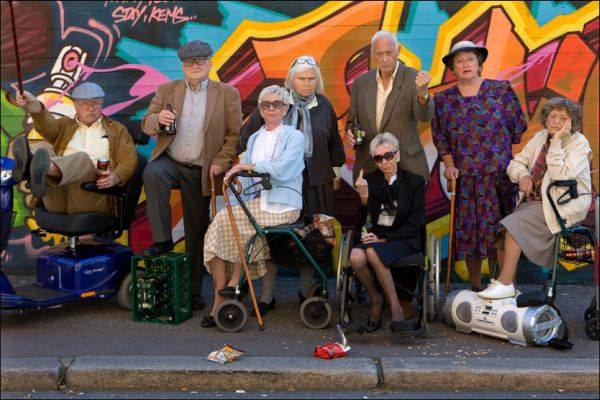 Two weeks back I had a day off and ran a Fate Accelerated game. The picture above gives you some idea who the party were. The set-up was the PCs were senior citizens in a shitty rest home called Sunny Valley, and in the middle of an escape attempt stumbled onto a Martian plot to invade Earth. It was silly. I didn’t completely know how to run the game (I’m pretty sure I tracked Stress wrong), but everyone had fun, and the oldsters saved the day. The party consisted of a retired detective, a military sharpshooter suffering from dementia, a hacker with ties to Canadian Separatists, and a former getaway car driver that operated a souped-up scooter. While prepping for the game I made some NPCs that either died or didn’t get used. Here they are:

Picture is Holger Czukay, bass player for CAN.
Dirk Ostergarten
High Concept: Elderly ex-biker gang member
Trouble: Trouble tends to find me.
Aspect 1: I’ve seen some shit.
Aspect 2: The Man’s always trying to pin shit on me.
Aspect 3: Where did I put my glasses?
Stunts: Dirty Fighter
(Dirk can improvise hand to hand weapons)
Grundy Style
(Dirk knows Pennsyltuckian martial arts and gains a +2 when forcefully attacking.)
One More Stunt to be determined in game.
APPROACHES
Careful: +2
Clever: +1
Flashy: +0
Forceful: +3
Quick: +2
Sneaky: +1
Refresh: 3
Stress:
Consequences:
2 – Mild:
4 – Moderate:
6 – Severe:

Patricia Highsmith is sick of your shit.
Ada Morgan
High Concept: A Mean Old Witch
Trouble: You say I’m cruel like it’s a bad thing.
Aspect 1: Ms. Taffy is my wittle sweetums.
Aspect 2: I’ve turned better men than you into toads.
Aspect 3: It’s never too early for a drink.
Stunts: No one suspects an old lady.
(+2 to sneaky when bluffing and hiding.)
Hexes and curses
(+2 to careful when creating advantages)
Demon familiar
(once per session Ms. Taffy may attack)
Careful: +3
Clever: +2
Flashy: +1
Forceful: +0
Quick: +1
Sneaky: +2
Refresh: 3
Stress:
Consequences:
2 – Mild:
4 – Moderate:
6 – Severe:
#
Now that work and grad school are both back up and running I don’t know when I’ll get the chance to run or play another game. Which is too bad since the summer game I ran here in town was fun, and ended on something of a cliff hanger with one character having a severe curse put on him.
The 4 Things People Talk About When They Find Out I Live In South Korea
It starts like this:
I’m back home visiting the States and out and about as it’s generally when I have a social life. I try to cram in as much time as I can visiting everyone I know. Invariably I’ll meet someone I don’t know and it comes out in conversation that I live in South Korea at which point they’ll slip into a script where they mistake things they’ve heard about South Korea for knowing something about South Korea. It’s like they can’t help themselves, and they have to tell me right now about one of these four things:
1. North Korea and/or the Korean War. It’ll be about the war if it’s an older guy because that’s the war the guys my dad’s age remember from when they were kids. MacArthur will get mentioned. If it’s a younger person they’ll go on and on about North Korea cribbing from Vice documentaries.
2. Asian Sex Tourism. This is always a younger guy and he’s incapable of not sharing everything he knows about sex tourism. I find it best to back away from these people and leave them as quickly as possible.
3. Plastic Surgery. Mostly women bring this up. And they may or may not bring up foot-binding as well. This is what I term an obsession with an obsession. And you can generally throw a wrench in the works by asking them if they think getting braces is plastic surgery. At least with this one I can have a conversation.
4. Dog Eating. Not as common as the above three, but still on the list. As with the Korean War and sex tourism when someone starts down this road I can actually see their eyes gel over as the obsessional script-worm burrows through their psyche and erupts from their mouth.
Why I Don’t Want To Read Your 9/11 Post
Here’s my 9/11 post. It might explain why I don’t want to read yours.
I was at work in Greenwich Village when the first plane hit. I heard the crash and went outside where I saw people in apartments at their windows and on their balconies looking downtown, so I went up to the roof and saw the first tower on fire. At this point I was the only one in the building and since I didn’t have a cellphone, I needed to get to a phone so I could call Jin. She would have been coming into the city through the WTC path station and I wanted to call her before she left and tell her that “something was happening”.
No one at that time knew what was happening, and I was thinking about how I’d wanted to go to the WTC station that morning and go to the Borders Books on the first floor. Jin had reached the Journal Square path station and heard what was happening and come back home. We hung up. I went back to the roof, bumping into a few of my coworkers. We all went to the roof. We all had numbed, confused looks on our faces. The buildings burned.
Incongruous moment one: the buildings were on fire and burning and there was such a mix of this is happening, but we’re also at work and the day’s routine must be adhered to that my friend Rob and I had time to go to the deli, which had other people in it, and buy coffee. We took it back up to the roof and stood there drinking over-sweet coffee from blue paper cups with Greek urns on the sides while the buildings burned.
We saw black specks falling from the building and speculated about their nature. Rob had had a studio grant to paint in the WTC and did panoramic landscapes from there. Another acquaintance now had the same grant and, although we didn’t know it at the time, she was down there in one of the burning buildings. She escaped. One of only a small number to do so from that floor in that building. The first tower collapsed and there was this scream from all around us, this moan from everyone watching that just gave way to silence.
Incongruous moment two: that silence.
Jesus. That silence.
We were far enough away that we couldn’t hear anything. Later I’d meet people who weren’t in New York that would say something like “It was like watching a movie”. This was nothing like a movie. The first tower fell without any sound and after it fell this cloud of paper rose up in the sky. From where we were those pages sparkled in the sun. They were beautiful. I know. I know. There was nothing beautiful about any of this, but there it was incongruous moment three. Beauty – maybe the way sharks are beautiful.
I could not watch the rest. I could not see the second tower fall. I went downstairs to be alone.
But the day didn’t end there. The more I remember that day, the more incongruous events occur: the mad rush to give blood for the “survivors”, we’d go from hospital to hospital, lines everywhere, but nothing to be done, a cop car passing coated in white dust, the sight of an artist who I had worked for standing in the middle of University Place crying. She’d lived 6 blocks from the WTC. She was frozen with shock and her boyfriend and I got her moving again. Uptown. Always that long procession uptown.
And then there were the days and weeks after. The checking in with everyone you knew. The National Guard soldiers in Jersey City standing around the armory carrying baseball bats. The way the news had no script. No one had a narrative for the event. And weeks later when I woke up to the news of an engine falling off a plane in Queens – I couldn’t bring myself to get on the train and go under the river to get to work.
I’ve never watched the TV footage of 9/11. The moments when it shows up in a documentary – I am shocked to the point of tears by it. Even in movies. I can’t watch the destruction of New York in some action flick (like The Avengers) without getting at least some small whiff of a panic attack coming on.
I think I’m still waiting for those incongruous moments to end.
August Books
Here’s what I read over my vacation. It would have been twelve books, but I’m still reading The Orange Eats Creeps, but it’s okay since that book’s like prose no-wave. I sometimes kick myself for not putting up more content here, but other than a weekly writing status report, which I suspect no one wants to read, I can’t think of anything to write for regular content. So monthly book reports it is.
The Drowning Girl – Caitlin R. Kiernan (2012): An impressionistic ghost story that might not be a ghost story, but more along the lines of a Blackwood story where someone encounters something and the something is unfathomable. Here we have a schizophrenic young woman encountering the unknown in the person of another woman, who may be a ghost, or a mermaid, or a wolf dressed in the skin of a girl. Atmospheric and weird in the best way.
Smonk – Tom Franklin (2006): Violent over the top Southern-fried Western populated by mutant cartoon characters armed with guns and high explosives. If you like your violence tobacco-splattered and foul-mouthed, you’ll probably like this.
The Dinner – Herman Koch (2013): Two brothers and their wives get together for dinner and attempt to come to terms with the fact that their sons committed a horrible crime that’s been caught on camera and broadcast around the nation. As the man-hunt remains ongoing each family prepares to do all it can to protect itself, including murder. A somewhat enjoyable book with an unreliable narrator, but I couldn’t help but feel that Koch required pages to tell you what Simenon would only have needed a paragraph and a few ellipses to do.
Missing out: In Praise of the Unlived Life – Adam Phillips (2012): One problem I have with nonfiction is that too often it reads like it would have made for a better article than a book, and that’s the case here. Some nice nuggets buried throughout such as: “We know more about the experiences we haven’t had than about the experiences we have had.” And Phillips then goes on to critique this omniscience and poke holes in it, but often I found the conclusions drowned beneath the erudition.
Killing Rage: Ending Racism – bell hooks (1995): Essays and analysis on racism in America. A counter-point to the Terkel book I read last month. I started it right after that book, but its density slowed me down and I ended up reading it a bit at a time week by week. I’ve recommended it to friends since then. Most people should read this.
Junky – William S. Burroughs (1953): I forgot how great this book was. Yeah. Burroughs was a criminal psychopath. There’s no denying that. But when writing white-hot, as he is here, his prose throws sparks off the page.
Resume with Monsters – William Browning Spencer (1995): Protag works a series of dead-end jobs while trying to get back together with the woman who left him (for good reason) and battle Cthulhu and assorted other Old Ones hiding out behind the facade of corporate America. If you’ve ever worked a shit job and had to suffer through horrible HR presentations than you’ll be simpatico to this book.
The End of Everything – Megan Abbott (2011): This was an amazing book, part detective, part coming of age novel, all riveting, creepy, and startling. A girl’s best friend is kidnapped the summer before they’re both set to begin high school, and sets in motion events that can only lead to an end of innocence and childhood. The brilliant thing in this book is the way the jaded PI trope gets upended by a girl playing detective who’s a complete innocent encountering a wider world of adulthood mystery.
I Have The Right To Destroy Myself – Young-Ha Kim (2007): A Korean novel from the mid-90s where all the women exist to commit suicide and the guys make art and dream about cars. I don’t know what to make of this book. It’s narrator is a bit Holden Caulfield-esque – if Holden was a serial killer going around Seoul convincing alienated twenty-somethings to kill themselves. And that’s what the novel sort of exudes and revels in: twenty-somethingness that mistakes a shallow morbid lack of empathy for profundity.
Storm Kings – Lee Sandlin (2013): Two-fisted tales of meteorology! This is a fascinating account of the oft-contentious history of American meteorology and storm chasing from the Colonial Era (Ben Franklin and his kite) to the modern day. The chapter titled “The Finger of God” is worth reading, even if it’s just in the bookstore.
Jack Glass – Adam Roberts (2012): Fantomas of the spaceways that sometimes downgrades to fan fiction for equations. I preferred the former more than the latter.
Random Acts of Senseless Violence – Jack Womack (1993): The Diary of Anne Frank meets Clockwork Orange by way of Gossip Girl set in a dystopian USA that looks more familiar than it should. At the end you either feel sad for Lola, its protagonist, or glad that she’s adapted to her changing environment. Worth tracking down.
July Books
I wanted to make July all about reading nonfiction, but that didn’t happen. Some fiction squeaked in. Plus I started more books than I finished, because nonfiction, so now I’m reading nonfiction in between and around fiction. An essay here, an essay there.
On a similar note, August was supposed to be all about Epic Fantasy but I picked up the first 700+ page book in the pile and cracked; my resolve fled and I said, “Fuck no!” Instead August is going to be all about stand alone genre novels. That’s what I’m writing, so that’s what I’m reading. Fuck Epic Fantasy.
On to the books:
 Race: How Blacks and Whites Think And Feel About The American Obsession by Studs Terkel.
I can’t believe I hadn’t read Terkel until now. This book was great. I feel like Terkel should be our (USian) default historian, like most citizens should read his stuff and be familiar with it even if you don’t agree with it. And there’s lots here. The whole book is interviews about race relations in and around Chicago from the 50s on into the 80s. A document of lives lived through the death of Emmett Till, the housing protests, Affirmative Action, the closing of the steel mills, and the rise of the Nation of Islam. Like I said, agree or disagree with the speakers here but at least have the conversation to happen. Here’s the quote the book ends on from a mixed race man named Leo:
“I have faith we can mature. Stranger things have happened. Maybe America, maybe the world is in its adolescence. Maybe we’re driving home from the prom, drunk, and nobody knows whether we’re going to survive or not. Maybe we’ll survive and maybe we’ll be a pretty smart old person, well-adjusted and mellow.”
 The Star Thrower – Loren Eiseley
I did blather some about Eiseley before and this book is as good as any other to jump into his stuff with. The titular essay is probably his most famous. It’s about encountering a man on a beach that throws dying star fishes back into the sea. But the essay I loved was called “How Natural is ‘Natural’?”. That one read like pure Arthur Machen mixed with Edward Abbey or Henry Thoreau.
“I too am aware of the trunk that stretches loathsomely back of me along the floor. I too am a many-visaged thing that has climbed upward out of the dark of endless leaf falls, and has slunk, furred, through the glitter of blue glacial nights. I, the professor, trembling absurdly on the platform with my book and spectacles, am the single philosophical animal. I am the unfolding worm, and mud fish, the weird tree of Igdrasil shaping itself endlessly out of darkness toward the light.
I have said this is not an illusion. It is when one sees in this manner, or a sense of strangeness halts one on a busy street to verify the appearance of one’s fellows, that one knows a terrible new sense has opened a faint crack in the absolute.”
Cosmic vastnesses indeed!
 Apparitions: Ghosts of Old Edo – Miyuki Miyabe
So, yeah. This book was why I didn’t finish more nonfiction this month. I was part way through bell hooks’s Killing Rage and Adam Phillips’s Missing Out when this book came along in the mail and I said, oh hey, let me read one of these stories and see what they’re all about. And that led to me reading another one and another one and another one.
These stories are pretty damn f’n great y’all.
Okay, so the only other Japanese ghost stories I’ve read are by Lafcadio Hearn and his wife Koizumi Setsu (and when people talk about Hearn’s Japanese work I think they should mention how it was a team effort between him and his wife), and also the work of Edogawa Rampo.
Miyabe’s are different from both of those.
Hearn and Setsu’s were all about the Japaneseness of the stories, because Hearn’s readers wanted exoticism. Rampo’s work took Poe and the conte cruel and mashed them up with their Japanese equivalents to give you such creep fests as “The Human Chair” and other nutty stuff.
In comparison to those Miyabe’s stories are more grounded in the everyday and mundane. They’re all about the marketplace and the ties of association between merchants in 18th and 19th centuries Edo. Each involves either an apprentice or bonded servant entering a situation where they encounter a ghost or demon. Their stories are intersecting other stories and that sense of indebtedness from one person to another is carried over between the living and the dead. Yeah, there’s nothing here that’s going to make me have to get off a crowded train like reading Rampo’s “The Caterpillar” did, but that’s not a bad thing. For a collision of the mundane and the fantastic these stories are perfect. Check them out.
 Yesterweird