For Future Reference


A couple of recent additions to Project Gutenberg that look like they might be worth a further look simply on account of their illustrations alone.
From Old Country Inns of England:
“In every manor there was held annually the assize of bread and ale, the two staple articles of diet which it was essential should be pure and of good quality. “Bread, the staff of life, and beer life itself,” not unknown as a motto on the signboards, is a saying that[Pg 97] has come down to us from a prehistoric period. And modern science, as it seems, is inclined to endorse the maxim. Good old-fashioned wheaten and rye bread, made from the whole flour from which only the coarser brans had been sifted, built up the stamina of our forefathers. Their chief drink was ale brewed from barley or oaten malt. The small proportion of alcohol served as a vehicle for the organic phosphates necessary for the sustenance of strong nerves, while the ferment of the malt helped to digest the starch granules in the bread. Bread and ale are still the main diet of our labouring classes—but alas! stale, finely-sifted flour contains a very poor allowance of gluten, and chemically produced saccharine is destitute of phosphates. O, that our modern legislators would revive the assize of bread and ale!”

And from The History of Mourning:
“The Italians, and especially the Venetians, spent enormous sums upon their funeral services, which were exceedingly picturesque; but as the members of the brotherhoods who walked in the procession wore pointed hoods and masks, so that, by the glare of the torches, only their eyes could be seen glittering, and as it was the custom, also, for the funeral to take place at night, the body being exposed upon an open bier, in full dress, the scene was sufficiently weird to attract the attention of travellers.”

10 Favorite Reads of 2013
Here are my ten favorite reads for the past year.
Yes, this list ignores publication dates, and the numbers are arbitrary.
1. A Pretty Mouth by Molly Tanzer
2. Memory by Linda Nagata
3. Snitch World by Jim Nisbet
4. A Stranger in Olondria by Sofia Samatar
5. Dagon by Fred Chappell
6. Temporary Agency by Rachel Pollack
7. Engine Summer by John Crowley
8. Fair Play by Tove Jansson
9. Linger Awhile by Russell Hoban
10. The Trouble With Testosterone by Robert M. Sapolsky
Books November 2013
A slow month for reading since I’ve gotten involved with Virginia Woolf’s Orlando. Here are the books I managed to finish:
1. At Amberleaf Fair – Phyllis Ann Karr
A mid-80s fantasy novel set at a seasonal fair and featuring miss-matched lovers, petty theft, and magic. It’s a bit of a curiosity: a secondary world fantasy crime novel where much of the world building and conflict deals with a barter economy and the small ways magic is integrated into everyday existence. At times the styles of the crime genre and the fantasy genre clash, and too often the novel sits heavily on the fantasy side and suffers for it. Still, I enjoyed it because it’s a small scale secondary world fantasy and I’m a sucker for those.
2. A House in Naples – Peter Rabe
A 50s pulp crime novel about two American criminals in post-War Naples. It’s a quick read, full of unlikable characters, and very ugly, but it’s better than most. If you have any desire to read pulp crime, Peter Rabe should be on your list of authors to check out.
3. The Digger’s Game – George V. Higgins
Crime circa-1970s Boston, I liked it but not as much as Cogan’s Trade or The Friends of Eddie Coyle. Still, when it’s good, it’s good and sections of the novel leap off the page. I should also thank Rick Bowes for making me read Higgins in the first place.
4. How To Make Friends With Demons – Graham Joyce
I could see a person hating this book. It meanders, withholds information, and for much of it you’re wondering when Joyce is going to a) get on with it, b) tell you what it’s all about. But if you accept those things and admire how he’s doing it all, then you’ll find much to enjoy here.
5. Storm of Steel – Ernst Junger
War is good! War is great! War! War! War! Junger was a German storm trooper during World War One. He enjoyed the war on the occasions when it wasn’t making him breakdown into fits of sobbing, and this book is his memoir of his experiences. There’s a part early on where Junger enters a field hospital after a battle and he describes the doctor as having a “cold, antlike efficiency in the middle of the carnage”. The book is full of a lot of that.
Know Your History? Some Guidelines For Reading
Every now and then the debate over reading genre classics pops up and rears its ugly head. On the one hand you have folks who feel we’re losing a literary heritage and forgetting too many old great books as new great books get published. Mike Swanwick had a recent blog post to that effect. The genre was once smaller, you could read everything in it, and stay on top of it. It was easier not only to find the firsts in a genre, but also the outliers. Having a hungry curiosity for this stuff is good.
On the other hand you have the opposite position of just knowing what’s current, which in its extreme form might resemble this five year old blog post from Karen Traviss about not needing to read to be a writer. (I don’t know if Traviss still agrees with that blog post, but I’ll keep it until I learn otherwise because it’s useful.) In its milder form, it’s not needing to read every alien invasion story ever, but just those in recent years in order to see how alien invasion stories are being told now in this era.
There’s also a third hand, which shows up in the comments of Swanwick’s post, stating that the “classics” might not be so classic and why navigate through books dripping with the prejudices of their eras. This too is a valuable point, but my reading of Swanwick’s post is one not so much telling writers to know their history and cling to it, but to sift that history and find the gems in it, the outliers as he dubs them, or the books lost in genre’s shadow like the ones I mention here and here.
However there are ways to reconcile these three arguments when you keep these guidelines in mind:
1. Read only what you enjoy, but cultivate a curious and complex palette that enjoys challenges.
2. Make your own genre history. Lots of stuff gets lost in the margins or ignored because it doesn’t tidily fit in with someone’s imposed narrative. Bring these works to light.
3. The early work in a genre has more immediacy than subsequent iterations. It can sometimes be as fresh as more recent works.
4. As far as knowing your genre goes, once you’ve read the initial spark, focus on what’s been done with it in the past decade. But…
5. Always remember there are likely more amazing books that you haven’t heard of than ones you have.
And here’s another post where I carry on in more or less the same way.
One Book, A Bunch of Covers: The Strugatsky Brothers’ Roadside Picnic
The Strugatsky Brothers’ novel Roadside Picnic is one of those books I read when I can’t find anything else to read. I can pick it up, read a bit, at least any of the Red Schuhart sections, then put it down for months on end. I was doing this last week while waiting for some other books to arrive.
For folks who haven’t read it, Roadside Picnic is an SF novel that takes place in a city after an alien visitation. These aliens are gone, but they or their technologically advanced artifacts have altered a section of the city. This area’s now called the Zone, and it’s heavily guarded and contained, but deserted. The area around the Zone is thick with operatives from various multinational companies and world governments. A thriving black market in alien artifacts exists fed by adventurers, such as Red Schuhart and others, who risk their lives exploring the Zone.
It was the basis of a Tarkovsky flick and a video game and you can make world parallels to Chernobyl, the Korean DMZ, and the Varosha area in Famagusta.
Anyway on to the covers–we’ll start with the non-anglophone ones since the book was first published in Russia. I don’t know if these copies are Russian or Polish. I snagged them from Goodreads.
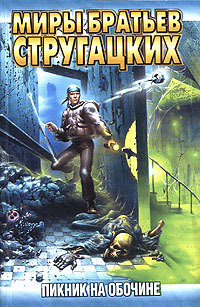
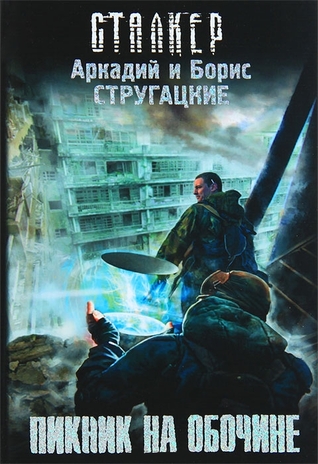
They look like your standard post-apocalyptic SF, and the one on the bottom seems to advertise it’s link to the video game/movie (both are called Stalker), while the top cover makes me a bit nostalgic for the crappy bookcovers of 1980s SF. But only a bit.
Now for four anglophone covers, which are kind of interesting because they show the way the book’s packaged differently for different audiences.


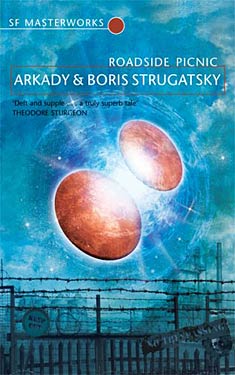

Three of these say SF novel. The top left screams it in all its ugliness. Stalkers are badass lowlives risking life and limb to sneak into a ruined factory in search of treasure. You can’t really be a badass while wearing a silver egghead suit. Top right is the version I own and has a decent understated 70s SF bleakness about it. Bottom left I like-but what it shows, a “full” empty, is boring, especially when you’re book’s about low-life, bad-asses yaddayaddayaddaing.
The fourth cover, bottom right, this one is the least SFnal of them all. Sure, Ursula LeGuin’s name is on the cover, and there’s mention of the movie and video game. But the image comes from the Tarkovsky movie, and there’s that “a new translation”, which I can’t help but read in a hushed, reverent tone. All that makes me think it’s being sold to readers of translated international fiction and Tarkovsky fans over SF fans. I’ve no problem with that, but it’s interesting to see how the book’s pitched for another audience.
Anyway, what do you all think?
One Book, Six Covers: Isaac Bashevis Singer’s The Slave


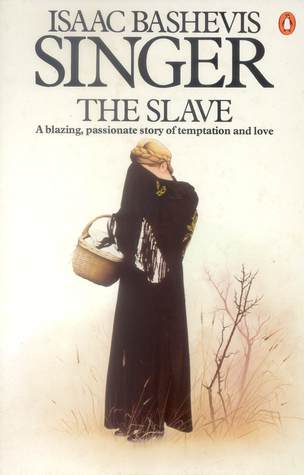
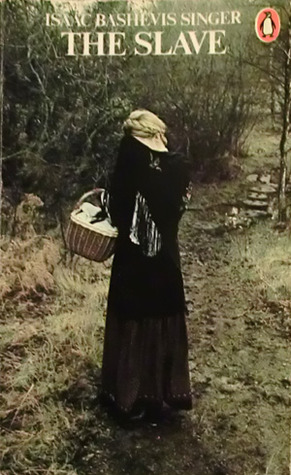
One of the books I read last month. When I was finished with it I checked out the different covers and decided to do a Four Covers posts.
Here’s what the book’s about: It’s the 17th century. A Jewish scholar is captured and sold into slavery after his town is massacred. He is devout, and does his best to maintain his faith among the rustic peasants he must now live among. His position among them is tenuous and he fears for his life. The one bright spot is the kindness shown to him by his owner’s widowed daughter. The two fall in love and plan to escape the village. They succeed, but only to now have to confront a new series of threats.
It’s a sad book, and much of the conflict is internal as the characters wrestle with their desires. From some of these covers you’d hardly know that. They’re selling some kind of Doctor Zhivago romance.
Cover one is bland. Cover two is Doctor Zhivago. Cover three is Ben Shahn inspired with Singer’s name larger than the title and selling the author. (This style is used for other Singer books by the same publisher.) Cover four is more Doctor Zhivago, putting me in mind of an adventure novel with its bright covers. Cover five is the version I read. It’s dull, and you can see how it’s taken from cover six. Cover six might be my favorite, in that it matches the book by suggesting emotional distress and suffering. Though you might think the woman is the slave, and for some reason it makes me think of a Thomas Hardy novel.
I bought the book because a) I like Singer, b) I found it for a buck in a used book store. If anything the cover with its blandness was more of a turn off than anything else, but still I enjoy seeing the different way books are packaged and sold. Especially ones like this, historical fiction by an author with literary status. You’re not simply reading a book, you’re reading a book by a Nobel Laureate. Someone deemed important.
Books October 2013
1. The Slave – Isaac Bashevis Singer
Singer’s The Slave tells the story of a Jewish man, Jacob, sold into slavery by the Cossacks and forced to live in a remote mountain village where he tries to maintain his traditions amid the idolaters and his own desire for Wanda the widowed daughter of his owner. Eventually the two fall in love only to have society, both Jewish and Gentile, spurn them.
It’s a terrific read, by turns beautiful and brutal, that attempts to explain why bad things happen to good people. Or maybe not even explain and just simply describe, so we can make up our own reasons why. When I retold the story to Mrs. Bad Habits, she gave me a look and said, “How could anyone possibly read something so sad?”
One thing I do love about Singer’s historical work is how well he fuses the natural and supernatural. The characters in The Slave live in a world of wonders, of ghosts, saints, and miracles, and that world view sings from almost every page.
2. Love is the Law – Nick Mamatas
Magick, murder, communism. If you liked the movie Brick but wished it was about a wise-cracking teenage girl with an orange mohawk, you’ll likely enjoy this. Surprisingly, unlike everyone I’ve ever known into Aleister Crowley, the main character doesn’t do heroin.
3. The Black Count – Tom Reiss
Pulitzer winning bio of Alexandre Dumas, father to the novelist, former slave, war hero, and revolutionary-era general – an overall fantastic read that not only focuses on the individual but the era he lived in. A must read for anyone who’s ever loved The Three Musketeers or The Count of Monte Cristo.
4. Twenty Fragments of a Ravenous Youth – Xiaolu Guo
A bildungsroman set in modern day Beijing. Fenfang, a young Chinese woman, leaves her home village for the big city where she finds work as a film extra. She’s snarky, disrespectful, and critical, but through bad relationships, bad roles, and the indifference of Beijing she stays true to herself. In the acknowledgements at the end Xiaolu Guo addresses the difficulties she had translating the work, not simply because the prose shifted languages, but she as a person shifted her stance on how she felt about Fenfang and her world. It might not be for everyone, but I recommend it.
5. My Antonia – Willa Cather
A book that’s both ugly and beautiful, My Antonia tells the story of an immigrant girl growing up in late 19th century Nebraska as seen through the eyes of her childhood friend. The beauty is there in Cather’s eye for detail whether natural or personal, but the ugliness goes along with it. There’s the intentional ugliness such as when a tramp farm worker commits suicide by throwing himself into a threshing machine, but there’s also the unintentional ugliness where Cather’s worldview rears its head like when she spends a page and a half describing how “hideous” an African American is.
I recommend it, but you’ll likely find a lot here to shake your fist at.
6. Turtle Diary – Russell Hoban
William and Neaera are two atomized and isolated individuals eking out their lives of quiet despair in 1970s London. William works in a bookstore. Neaera writes kids books. Each unbeknownst to the other starts having “turtle” thoughts after they visit the zoo and see the sea turtle enclosure. Soon their collaborating on a scheme to set the animals free. Fortunately for the reader it never becomes a romantic comedy, but something more life affirming.
It’s Russell Hoban. He could write derpderpderp for 200 pages and I would still like it.
7. Dirty Weekend – Helen Zahavi
Bella lives alone in a basement apartment, and her neighbor starts harassing her. One day she wakes up and decides she’s not going to take it anymore. What follows is a blood-splattered and violent weekend, where Bella transforms herself from victim to avenger. It’s a grim book, but compulsively readable that inverts the noir trope of the femme fatale, while reading like, as one tag on the book put it, Oscar Wilde writing Death Wish.
8. The Voyage of the Short Serpent – Bernard du Boucheron
An award-winning debut novel by a seventy-something year old author. Du Boucheron raises the bar for all of us.
In the Middle Ages a Catholic inquisitor is sent to the isolated Christian communities in Greenland where he finds a land ravaged by privation, cannibalism, and a host of other sins. One of those books where horrible people do horrible things and you know you can’t trust the first person narrator because they’re not telling you the true story. Yet despite all this the narrative remains compelling and the story unfolds at a rapid pace. Parts of it reminded me of McCarthy’s The Road, but even more of it reminded me of Stewart O’Nan’s Wisconsin Death Trip-inspired horror novel A Prayer For the Dying.
9. The Secret Commonwealth of Elves, Fauns, and Fairies – Robert Kirk, ed. Andrew Lang
An extremely short book written by a 17th century Scottish parson approaching the question of the second sight and fairies as both a believer and a naturalist with the express intention of refuting skeptics and atheists. In other words, it’s a loopy book written in a sanctimonious and turgid style, a fact not helped by having a Victorian “psychical” researcher as the book’s editor a century.
Stay Off The Road
The roads were dangerous at night. The King’s Daughter, filthiest of witches, confused travelers and shoved them into bogs. The demonic Lillies made their homes in caves and the hollows of tree trunks. Ygereth, Machlath, and Shibta enticed men off the highway until they defiled themselves with nocturnal emissions. Shabriry and Briry polluted the waters of springs and rivers. Zachulphi, Jejknufi, Michiaru, survivors of the generation that had built the Tower of Babel, confounded men’s speech and drove them mad or into the mountains of darkness.
– from The Slave by Isaac Bashevis Singer
Happy Halloween!
The Black Book AKA Reign of Terror
 I’m on a bit of a French Revolution kick, mainly because I’m reading that Tom Reiss biography of Alex Dumas, French revolutionary era general, ex-slave, hero, and dad to the novelist, Alex Dumas. It’s proving to be a pretty great read.
One thing that surprises me is the fact that no one’s ever done a Cthulhu mythos, French Revolution mash-up. So much of it seems like it would fit together: secret societies (the Jacobin clubs), the Cult of the Supreme Being, the master/pupil relationship between Saint-Just* and Robespierre. I could see it working and am surprised no one’s done it.
One thing I did find is this old costume drama from the 1940s called The Black Book. It’s one of those pictures where time and space can be conquered simply by showing a single silhouetted rider cross the screen while the music score swells. “… and he made full speed for Strassburg.”
What’s cool about it is that it’s directed by Anthony Mann. Mann started as a b-movie director, specializing in Film Noir and went on to make westerns and epics. The Black Book is made right in the middle of his Noir phase, so it plays out less like an epic of the revolution and more like The Maltese Falcon. Robespierre hires a special operative to find his missing black book. Several other factions want the book. There’s a femme fatale, a shady cop adept at picking locks, and double crosses. Yeah, it all descends into mad coach rides and women-in-peril, but at seventy-five minutes I won’t complain.
You can watch it at the Internet Archive or Youtube.
* According to wikipedia, Saint-Just wrote an epic poem in the style of Orlando Furioso, except with dollops of the Marquis de Sade heaped in. Yet another reason he’s perfect as a Lovecraftian anti-hero.
Turtle Diary
People write books for children and other people write about the books written for children but I don’t think it’s for the children at all. I think that all the people who worry so much about the children are really worrying about themselves, about keeping their world together and getting the children to help them do it, getting the children to agree that it is indeed a world. Each new generation of children has to be told: ‘This is a world, this is what one does, one lives like this.’ Maybe our constant fear is that a generation of children will come along and say : “This is not a world, this is nothing, there’s no way to live at all.’
– Turtle Diary, Russell Hoban
 Yesterweird