One Book, Four Covers: Jack Vance’s The Dying Earth


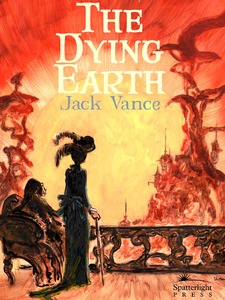

Jack Vance died two weeks back at the age of 96.
I loved the Dying Earth stuff from the word go, preferring Rhialto to Cugel, because WIZARDS, and I’d say his Demon Princes series is one of the best satires of SF written.
There’s been a lot written about him since his death, at least in the nerdosphere I inhabit, so it’s only apt to give him the One Book, Four Covers treatment.
Number one, by Ed Emscwiller, is my favorite. Sparse and slightly weird with its tentacled beasty. Then there’s number 3, which I think is really nice in capturing the book’s juxtaposition of the otherworldly and high society. Makes me dream odd dreams of Ms. Marple pitting her skills against Iucounu the Laughing Magician. The fourth cover is a bit too cheery. And then there’s the second cover with its John Berkey (I think) cover. It’s a fine picture but it’s stock like the art director pulled it out of a drawer to spare the expense of commissioning new artwork. It’s meh, which is a shame.
Also let me say how much I really hate Omnibus editions. As someone who did much of his reading on public transportation for years, it was a true pain in the ass to read a thick book on the bus or train. Paperbacks you can fit in your pocket – that’s what I’m all about.
May Books
1. The Witches of Karres – James H. Schmitz. A fun little Space Opera novel. Captain Pausert is your typical rogue with a heart of gold starship captain, long on luck, short on credits. He rescues a trio of slave girls and is soon caught up in a series of adventures. It’s a light-hearted book that gets more than a little wonderful in places. Occasionally it has a sour note (mostly of the precocious teenage girl that flirts with an older man that resembles her father variety), but there’s also much to love: monstrous planets, spider-robot assassins, weird world building, etc.
2. Fury – Henry Kuttner. Classic science fiction of the egomaniacal supermen and the ballgown-wearing women who love them variety. Deliriously fun. Weird narcotics, crime, murder, and mayhem all in the name of progress because man’s destiny is to rule the stars!
3. A Stranger in Olondria – Sofia Samatar. An amazingly rich and textured fantasy novel about a young scholar’s attempt to free himself from a ghost. There’s a lush world to get lost in here, of history and story, without any bloated POV immediacy or tedious door opening. It reminded me of the best bits of Jan Potocki’s Saragossa Manuscript. Read it.
4. Snitch World – Jim Nisbet. A small time crook collides with amoral dot-com venture capitalists in modern day San Francisco. What plot there is focuses largely on a top secret under development phone app, but the real entertainment is in Nisbet’s prose and vivid depiction of San Francisco. An enjoyable book, both funny and sad in a “Those days are gone, but the people live on” kind of way. Folks who have lived in San Francisco may also get an extra kick out of it.
5. God Save the Mark – Donald E. Westlake. A comedy of errors dressed up as a noir novel and populated with hard-nosed cops, femme fatales, and con artists, all of whom are out to get the most gullible man in Greenwich Village. An entertaining book.
6. An Artist of the Floating World – Kazou Ishiguro. A short, bitter-sweet novel about an elderly Japanese man coming to terms with life in post-war Japan. The narrator shies away from the crux of his problem, and the reader is left to surmise via oblique plotting what it is he did in his past that he’s so ashamed of now. It never quite matches The Remains of the Day, but the moments when it is good are very good indeed.
7. Nobody Move – Denis Johnson. A bit of a whirlwind ride as lowlives and petty crooks maneuver and manipulate each other for revenge, kicks, and greed. Johnson tips his hat to the masters, and noir and thriller fans will find enough here to keep them satisfied. It reminded me a lot of Jim Thompson’s The Getaway.
8. The Status Civilization – Robert Sheckley. It’s 1950s SF in the hip mode (think Bester and Pohl) with one of those What-If planetary monoculture set-ups. What if a world was populated by mental patients? What if a world was populated by Medieval re-enactors? In this case it’s What if there was a prison world where evil was considered good? It’s dopey, not completely Bizarro World, but certainly not The Dispossessed either – and every now and then the satire’s quite nicely sharp and pointed.
9. American Gods – Neil Gaiman. Overwritten and much of the first half is a drive-to-the-plot plot, that morphs a bit late into the picaresque, which sadly stops just as it hits it stride and becomes a sit-and-wait-for-the-plot-to-happen plot. It’s also written in that let-me-describe-everything-to-you style that makes good 60,000 word novels into shitty 120,000 word novels. Would I have liked this book more if I hadn’t already have read tons of Chesterton, Leiber, Barker, etc. couldn’t see the lineages of the book’s ideas? But would I have read Chesterton if I hadn’t read Sandman as a weird comic-reading teen nerd? That’s the question.
Fury by Henry Kuttner

Henry Kuttner’s Fury is one of those golden age SF books full of egomaniacal supermen and the form-fitting ballgown-wearing bombshells who love them. It’s overwrought and dopey, but also wonderful and deliriously entertaining.
Here’s your sentence of world building:
“The Earth is long dead, blasted apart, and the human survivors who settled on Venus live in huge citadels beneath the Venusian seas in an atrophying, class-ridden society ruled by the Immortals – genetic mutations who live a thousand years or more.”
Sam Reed’s an immortal too but he’s raised as a short-termer because his father’s insane and disowned him. So Sam lives on the wrong side of the tracks and gets involved with various criminals such as the Slider and the Sheffield Gang. Oh yeah, everyone has names like they might have worked at a 1950s Madison Avenue ad agencies, despite it being the 27th century. Sam finds himself at odds with the immortal Harker family (which he’s a member of but doesn’t know it) and the stage gets set for a confrontation. There’s a lot of yelling at each other over skype televisor and weird drugs get tossed around. Sam winds up losing the first round and put on ice for forty years. When he wakes up he’s pissed, but also surprised to realize he’s an immortal too.
A new battle of wits ensues played out with propaganda and the manipulation of the mentally unstable. Sorry, cuz. Sam swindles his way to temporary victory, and soon he’s backing terrorism and manipulating the masses with fear and false promises in order to achieve his ends. But all of it’s too much and the remaining immortals hatch a plan to breed an infiltrator assassin to take Sam down in a couple of decades. There’s more yelling. Sam gets needle-pistoled by his secretary and right when it looks bad, Mr. Ages shows up and says, “Well Sam, you’re a great Machiavellian dictator and humanity needs people like you from time to time to keep itself from stagnation. But you’re too unstable and prone to violence. So, I’m just going to keep you on ice until the species needs you again.” THE END.
Then there’s the epilogue where Sam wakes up again, and the book stops right there mid-sentence.
It’s a dizzy ride, full of fun stuff that you could probably make a great RPG setting out of: a hostile environment full of monsters, strange drugs and devices, mercenaries and criminals, bomb-shelter Keeps, immortals, and ruined settlements. It’s a quick read, by turns jaw-droppingly good and jaw-droppingly dopey like a soap opera. You can probably find it (either as Fury or by its alternate title Destination: Infinity!) for a buck or two in a cardboard box at your local nerd-emporium.
It’d certainly be better-spent money than the admission price to any half-dozen recent sci-fi movies.
April Books
Last Dragon – J.M. McDermott
A strange bit of epic fantasy that’s ambitious in style but lacks a certain cohesion, so there are parts I enjoyed but other parts that didn’t quite click together. That said, it was certainly refreshing to read secondary world epic fantasy that wasn’t simply one damn thing after another for six hundred plus pages. This reminded me a bit of Peter Beagle’s Innkeeper’s Song. That didn’t in any way attempt to be epic. This did and suffered for it, but still was a curious and enjoyable read.
War Fever – J.G. Ballard
A much more varied and better collection (IMO) than Vermillion Sands, Ballard’s work in the 1980s had all the joy of a buzzard tearing into the rotting guts of wildebeest. My favorite story would definitely be “A Secret History of World War 3”, but there are plenty of others to enjoy.
The Best of All Possible Worlds – Karen Lord
An advanced interstellar civilization must survive and adapt on one of their colony/client planet’s after a disaster destroys their home world. Classic Space Opera that reads like a season of Star Trek where Ursula K. LeGuin served as head writer. I enjoyed it.
The Werewolf of Paris – Guy Endore
A mélange of scandal and horror (S&M, rape, incest, cannibalism, etc.) mixed with the scolding tone of propriety, set amid some bastardized Victor Hugo meets the Marquis De Sade French backdrop.
One Book, Four Covers: Guy Endore’s The Werewolf of Paris


This book is pretty terrible, but it’s Fantomas terrible (if you read it fast enough, it’ll give you a contact high) so there’s something to be said for that.
Long considered the werewolf novel, Guy Endore’s The Werewolf of Paris reads like a mash-up of Les Miserables with the works of the Marquis De Sade. The novel centers on the plight of one Bertrand, afflicted from birth with lycanthropy. His step-uncle knows what Bertrand is and tries to curb B’s worse tendencies. But to no avail. Bertrand escapes and makes for Paris where he gets embroiled in the Commune.
Reading this was a bit like the weekend I spent at my grandmother’s house alternating my reading of the Monster Manual with her back issue stack of National Enquirers. It’s lid-off-the-id stuff, but the id of your grandparent’s generation, which makes it a bit sleazier, weirder, and unexpected. Murder, rape, torture, incest, and S&M abound, but the book succeeds in being both sleazy and prudish, tut-tutting at its own excesses. Read it for you want a piece of Gothic fiction ramped up to 11 and don’t mind how clunky the prose is.
March Books
I started grad school and am much busier this year than I have been in a while. The blog is likely to be the least of my priorities.
Here’s the book list for last month:
Alchemy and Alchemists – C.J.S. Thompson
Interesting and esoteric the best chapters are full of anecdotes from the lives of various alchemists.
Trafalgar – Angelica Gorodischer
Reads a bit like sitting in a cafe with your grandmother’s youngest brother, the great uncle that traveled everywhere and never seems to stop smoking, drinking coffee, or holding your interest with the accounts of his adventures.
Fremder – Russell Hoban
This book is a beautiful sloppy mess of Science Fiction. It’s one of those books I can crack open at random and just get hit by the prose all over again all. Dig:
“Maybe for some people the business of knowing who and what and when and where they are is simple; not for me. The past and the present flicker together in my mind and it isn’t easy to sort through the different strands of story to find one that is only mine.”
And:
“A373 and Badr al-Budur are two of the quiet places in my head. I like sometimes to think of Pearl speaking in my mother’s voice under the red Isis moon and I like to think of the robot sweepers humming through the silence of the spaceport under the noctolux lamps of Badru.”
The Company – K.J. Parker
Ugh. A hard slog. There are parts of Parker’s fiction I really like, and parts I hate. Everyone ends up having a secret and whichever secret winds up being important to the plot hardly matters (or I could care less). In between the whole story is shown in a matter-of-fact fashion where everything, past, future, interior, exterior has the same emotional weight and the whole novel loses its intensity. Maybe if it were 100 pages shorter, it would actually read like a novel.
Cogan’s Trade – George V. Higgins
An obliquely plotted crime novel with well-observed details and crackling dialogue. The ability for so many people to say so little while saying so much is amazing. Especially interesting of your family is like mine and enjoys playing six degrees of Whitey Bulger.
Ammonite – Nicola Griffith.
Loved it. The book’s a “classic” SF adventure story mixed with interesting world building of the LeGuin sort. A fun read.
The Queen, The Cambion, and Seven Others – Richard Bowes
A great collection of modern fantasy stories and warped fairy tales with Arthur and his Knights, Merlin and Queen Victoria, animal helpers, and the Kingdom Under the Hill – all are here and familiar, but subverted in interesting and refreshing ways. Definitely recommended.
The Enemy Within: A Short History of Witch-Hunting – John Demos
A decent overview of “witch-hunting” from Roman times up to the 1980s with a focus on Europe and America and lots of details on the Colonial era “witch-hunts”. Demos uses the term “witch-hunt” in a particular way, so brings up the various Red Scares in US history and the day care scandals of the 1980s. An enjoyable read if you’re into that sort of thing.
The Other Book
The book I’ve been reading started to piss me off so I’ve started another, a reread of Fremder by Russell Hoban. The book’s a beautifully lean, but sloppy mess. I love it.
You know how it is when you’re sitting in a bar somewhere dark and quiet just breathing in and out and maintaining neutral buoyancy and a stranger starts talking to you and after a while he brings out of his pocket a letter coming apart at the creases; he brings out this letter to show you that at one time he mattered more than he does now and he tells you the story of his life. At first you wish he’d go away but perhaps you say to yourself, Maybe one day I’ll want somebody to listen to my story. Never mind. My name is Fremder Gorn. Fremder means stranger in German. – Fremder by Russell Hoban
Lois the Witch and Other Stories

My review of Elizabeth Gaskell’s Lois the Witch and Other Stories is now live at Innsmouth Free Press as part of their Women in Horror Week. Like most Victorian writers Gaskell wrote her share of ghost stories and those in the collection are a nice grim assortment. Not only that but I suggest that Gaskell’s ghost stories serve as proto-noir and precursors to the works of Patricia Highsmith, Shirley Jackson, and Dorothy Hughes.
I also make a joke about bonnets and four-in-hand neckties.
Go check it out.
All of the Faces
“All of the faces, young, old, male, female, white and brown and black, were part of the many faces of the great sad thing that moves itself from here to there and back again in all forms of transit. Faces staring into space, faces reading faces looking inward at the stories inside them.”
– From Russell Hoban’s Linger Awhile
 Yesterweird