The Korean Word For Alibi
Today’s question: “What did you do last weekend?”
Today’s answer: “I killed a chicken with Minsu.”
Followed by…
Minsu: “No. No. I did nothing, teacher. Nothing!”
Shadows of Lost Rivers
Here’s something.
Back at the beginning of this year Beneath Ceaseless Skies published a story of mine called “Shadows Under Hexmouth Street”. (That’s the link to it. You can read it later.) One of the inspirations for that story was an article I read about subterranean rivers in Greenwich Village. The article included an apocryphal story of someone fishing for blind crayfish through a manhole cover in the basement of their apartment building.
Today I found out about a documentary called Lost Rivers.
It sounds pretty neat.
The Other Side of McMedieval Feudalism, or The Use of Mythic Distance in Malory’s “Le Morte D’Arthur”
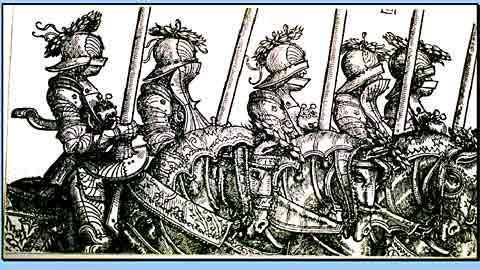
So that fascinating thing I hinted at about the setting in my last post about Le Morte D’Arthur – it’s totally generic McEurope, but instead of this being a design flaw, it’s a design feature.
Actually calling it McEurope is too specific. It’s more McMedieval Feudalism seen from the top without ever looking down. It’s an aristocracy divorced from all other social classes with an endless supply of weapons and armor to fight with. You have to at least enjoy that stuff as aesthetic trappings without any attendant realism. Only once does someone go to town and see a craftsperson to get a thing fixed. That’s your realism. Peasants hardly ever appear in it, and knights apparently have nothing better to do than stand all day beside bridges challenging whomever happens to walk by. “None shall pass”, etc.

What locales there are all blend together. Bridges, cloisters, and wells with maidens (or knights) weeping beside them lend some decoration to the otherwise indistinguishable setting. There are castles, and outside every castle is a forest. Inside the forest adventures happen.
But I said this is a feature rather than a flaw. What makes it fascinating is how quickly bright sanitized McMedieval Feudalism can become weird foreboding mythic id-laden fairyland. The one rule is when you go into the forest stuff happens to you. That stuff can be the frat-house jousting (with accompanying sides of homoeroticism and misogyny), or something a lot weirder and subconsciously ripe. It’s no surprise that “the forest” gets transformed into “the wasteland” during the Grail Quest.

What to make of this? On one hand the setting is so bland and divorced from reality as to be nonsensical. On the other hand that blandness has an advantage when telling a story and playing with archetypes, especially because the bland is divided in half, a mundane world and its fantastic reflection, and the archetypes are never quite certain when the one will shift into the other. Not just this, but any deviation from the uniform setting stands out.
So it’s okay to be bland as long as it’s a conscious choice. Use it to your advantage. Dive deep and swim in the dark waters waiting beneath the bland’s placid surface. Find those pearls waiting down there along with those toothsome beasts. What you find might be wonderful or it might be ugly, but it won’t be bland. That’s for certain.
Your Guide to Le Morte D’Arthur
First thing you need to know is Monty Python totally nailed it. Read the book, then watch the Black Knight “None shall pass!” scene, and you’ll agree. They nail it.
Second thing, all the knights are jackholes especially Gawain. (An arguable exception is Galahad, but he’s basically Jesus. Okay. There’s a few others who aren’t so bad, but it’s like five guys out of a thousand.)
Third thing, Malory didn’t invent any of this stuff. He edited oral traditions, pieced together narratives, and slathered on a layer of romanticized 14th century Christian chivalry to make the pre-Christian folk heroes palatable to his audience. He also wrote it in jail for a rather impressive laundry list of violent crimes, so when the knights behave terribly you have to figure old Tom knew what he was talking about .
The book’s divided into eight “tales”.
1. The Tale of King Arthur.
You have to read this. It has Merlin, Excalibur, and Arthur’s rise to power. In the first ten pages eight hundred named characters show up. Stuff happens and the jousting is still interesting.
2. The Tale of King Arthur And The Emperor Lucius.
This is great. Arthur unites England and marches on Rome. Rome has giants in its army. Much of it reads like a ten year old freeform rambling a D&D game. “You walk into the room and there are two hundred giants there. Roll for initiative.”
3. The Tale of Sir Launcelot Du Lake.
I have no memory of what this was about. I suspect it was dull, because Launcelot is dull except during the quest for the Holy Grail, when he’s basically having a bad acid trip.
An aside, throughout the book there’s a very keen ranking system of knights that’s reminiscent of a baseball fan’s fixation on batting averages, only it’s jousts and sword-fights being counted. So a knight shows up and everyone says, “It’s Sir Hoppinscotch. He’s the 36th bestest knight in the realm. Let’s see how he does in the left-handed face-smash head-kebob event.”
4. The Tale of Sir Gareth.
This book is fun. Gareth is Gawain the Jackhole’s half-brother, but he’s cool and not at all like Gawain. (Gawain kills their mom when he busts in on her and her lover even though dad’s been dead for years.) Gareth’s like the third best knight in Camelot, depending on if Sir Lameface is dead or not. He has adventures and they are interesting.
5. The Tale of Sir Tristram of Lyoness.
By now it’s all knight-errantry and jousting with the occasional interesting bit like La Cote Male Tayle or Sir Palomides trip to the Red City. It’s 200 pages that read like 800 pages each of them nearly identical and looking like this:
”One morning Sir Launcelot left the castle and rode into the forest. Soon he came upon a well where a maiden was weeping. She said, “Oh good knight can you protect me from the knight who is chasing me?” Sir Launcelot said “Yuppers” and rode off to meet the knight and did so by the bridge where they jousted and both were knocked from their horses. They then fought with swords for so long that the blood ran from their armor and soaked the ground. Finally Launcelot said: “Who are you knight that is so strong?” The knight removed his helmet and it turned out to be Sir Tristram, and the two embraced and shared kisses for they had long pledged loyalty to each other, at which time the maiden appeared and Tristam chopped off her head because she was a sorceress.”
It’s wretched. The big thing is Sir Palomides is in love with Iseult the Fair and it makes him a complete jackhole.
6. The Tale of the Sangreal.
This is awesome Pagan-Christian Mystic hallucinogenic weirdness. Loopy stuff as if the knights of the Round Table got lost in a stoner-metal album. I suspect Malory was mining a tradition here well beyond his usual — and the only way he could make sense of it was basically having Galahad be Jesus, which kind of sucks deus ex machina and all that, but the whole thing is so weird that you just have to go with it. Or read the Mabigboingboingoinen to get the pure stuff.
7. The Book of Sir Launcelot and Queen Gwynevere.
Launcelot’s been schtupping the Queen. (Like you didn’t know.) Arthur finds out. Mayhem ensues.
8. Le Morte D’Arthur.
Arthur dies. It’s the name of the book. Everybody else dies too, or goes away and becomes a hermit/nun.
* * *
There’s actually some fascinating setting stuff here that I’ll probably get into next time.
What We Post About When We Post About Gaming
Here’s my list of what I bring to the table when running the Vaults of Ur.
1. Red Tide.
2. Chronicles of Future Earth
3. Basic Labyrinth Lord
4. Vornheim
5. Moldvay Basic
But pretty much it’s Moldvay Basic.
(The party’s totally up a creek without a paddle right now. It’s great.)
Konk!
 So I get these awful headaches. I don’t know what causes them. They basically creep up on me and floor me for a day or two. This weekend has been one of those instances. I slept twenty hours on Saturday and hardly moved from the bed today. My doctor (God bless him and his luchador mask) told me not to take any caffeine or alcohol when I get them, so I’ve tried to stick to that.
But, jeez, what a drag.
Anyway, enough of my whining, here’s Lewis Carroll from his pamphlet Feeding the Mind:
“To ascertain the healthiness of the mental appetite of a human animal, place in its hands a short, well-written, but not exciting treatise on some popular subject—a mental bun, in fact. If it is read with eager interest and perfect attention, and if the reader can answer questions on the subject afterwards, the mind is in first-rate working order. If it be politely laid down again, or perhaps lounged over for a few minutes, and then, ‘I can’t read this stupid book! Would you hand me the second volume of “The Mysterious Murder”?’ you may be equally sure that there is something wrong in the mental digestion.”
I Take It All Back

Scum Beach isn’t so bad.
One Book Four Covers: Vermilion Sands by J.G. Ballard



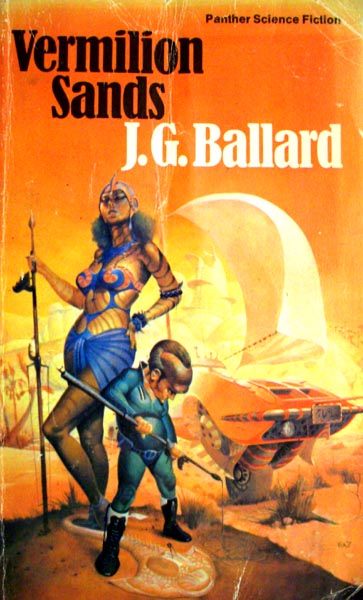
How about those covers, eh?
I dig the ones at either end, although the left one fits the book better. That one on the right, though? Gosh. I totally want to read that book.
For folks who don’t want to Google, Vermilion Sands is a fictitious resort at some undetermined time in the near future populated by the bored, artistic, insane, and/or wealthy. Ballard said his inspiration was Palm Springs, but I always imagine a Mediterranean locale. It’s also one of those books you’re either going to love or hate. If you’re a Ballard fan you won’t really mind that every story is more or less the same featuring nearly identical characters and plots. If you’re not a Ballard fan then I’m sure that will bother you — but only if you try to tackle the book head-on. If you were to approach each story on its own, you’d probably have better luck.

 Yesterweird