Orlando Furioso, Canto IV

I made the comment on twitter that I am glad I skipped the introduction because I fear it would’ve tried to make me think this was a book to be taken seriously. A Dante’s The Divine Comedy, instead of what it actually is: a 16th century run of Avengers comics. The whole thing reads like Ariosto took all the legends and epics he knew and mashed them into one continuity Crisis on Infinite Earths style. And I’m here for it.
Plus it’s really good bedtime reading.
Last canto we ended with Bradamante meeting Brunello. Surprisingly in this Canto we stay with them. The crashing that ended Canto III turns out to be the necromancer flying by on his winged horse.
“Sometimes high up among the stars he flies
At other times close to the ground he’ll skim,
And any lovely woman whom he spies
He snatches up and carries off with him.”
Bradamante and Brunello agree to join forces and travel together to the necromancer’s castle. Both have their own reasons to want Ruggiero freed. Surprising me again, nothing happens to them on the road and after about three dozen lines of hill and dale climbing descriptions, the pair come to in sight of the necromancer’s castle. Promptly, Bradamante attacks and defeats Brunello, stealing the magic ring he carries. However, contrary to the enchantress’s advice Bradamante doesn’t kill Brunello but leaves him tied to a tree. She then goes on to the necromancer’s castle and blows her horn in challenge.
“Not long the man of sorcery delayed
When he had heard the challenge of the horn.
On his winged horse, towards the warrior Maid,
Whom he believes to be a man, he’s borne.
A word here about our necromancer: it’s hard not to read him in science-fictional terms as someone from an advanced tech civilization living on a primitive world. He has a winged “horse” that makes a loud booming roar when it flies, access to magic items (a shield that shoots a stunning light and a book he uses to conjure weapons), and he lives in a towering castle made of steel. I’ve read Gene Wolfe. I’ve played Numenera. I recognize this guy.
“His shield in a vermilion cloth was draped.
In his right hand he held an open book,
Whence marvelous phenomena he shaped:
A lance which hurtled through the air and took
His adversary by surprise, who gaped
At nothingness, with an astonished look;
Or with a dagger or a club he smote
From far away, by a control remote.”
By a control remote. . .
You can’t fool me Ariosto! This ain’t no wizard. This is a traveler from the far future fighting with a stun ray and nanite swarm. There’s also something, something about his horse.
Bradamante and the necromancer fight, and the necromancer enjoys himself, drawing the duel out to get his cruel kicks. Bradamante however feigns being worse off than she is, and when she swoons before the stun ray she does so while completely unscathed. But the necromancer doesn’t know this and goes to claim his prize when Bradamante leaps upon him and strikes the magic book from his hand. She quickly subdues him and claims his gear as her own, then gets ready to chop off his head only to realize he’s a withered old man. He’s like kill me already, and she’s like no. You need to tell me why you’re kidnapping knights. And he’s like I kidnapped the knights to keep Ruggiero company. And Bradamante’s like why are you keeping Ruggiero captive? And the guy is like because if Ruggiero becomes a Christian he’ll die. He also says his name’s Atlante. Bradamante commands him to open his prisons and PLONK, out come a host of knights and their horses.
There’s Gradasso, Sacripante, Prasildo, and Iroldo, all people I assume had their own comic books in the 16th century. At last, there’s Ruggiero. And there’s much gladness when he sees Bradamante – but Atlante escapes and takes his steel castle with him. The winged horse however stays behind and all the knights try to catch it. It flies in little hops, first here, then there, all the while it’s being controlled by an invisible Atlante. At last the horse lands in front of Ruggiero, and he climbs astride it. At which point, Atlante launches the horse straight into the sky. Atlante hasn’t given up on his mission yet.
And then Ariosto does a scene change…
When last we left Rinaldo he was on a boat making for England and the waves were high and all looked lost, but it actually wasn’t that bad. They land and Ariosto’s Britain is a chivalric hellscape of Arthuriana where the never ending clash of arms echoes through the forests. All of which sounds great to Rinaldo who sets off at once to seek adventure. Staying one night at a monastery he learns how the local king has condemned his daughter to death because she slept with her boyfriend, and Rinaldo is like you’re king’s an ass. He then gives some sex positivity discourse on how it’s no big deal that a damsel gave her lover solace in her bed. Long story short, Rinaldo sets out to rescue the princess. And promptly assists another damsel in distress being attacked by ruffians.
How did she end up here? Well, that’s what Canto V will attempt to make clear.
Until next time! May your sword stay sharp!
Orlando Furioso, Canto III

Hey,
Did you know that Ariosto was sponsored by the D’Este family?
Do you know who the ancestors of the D’Este family were?
Turns out they were Bradamante, that lady knight of great virtue, and Ruggierro, that guy knight of great virtue. But wait you say, aren’t they on opposite sides of this war between Christian and Saracen? Why yes, that’s true. They are on opposite sides of the war, but they have destinies, and one of them is to get married, found the D’Este family, more to Ferrara, and make it the best place on Earth to live, or at least so says Ludovico Aristo, native of Ferrara and proud supporter of the D’Este family.
And that’s this canto.
Pinabel suspects Bradamante is still alive and decides he should vacate the premises. He does so, but not before stealing Bradamante’s horse. Bradamante survives her fall and discovers a door in the cave. This door leads to a bigger, better cave of finely crafted columns. In the center is an altar with a lamp burning on it, and the sight of this makes Bradamante kneel and pray. A sorceress appears and starts talking. The sorceress knows many things. For one she knew she and Bradamante were destined to meet. She also knows the cave was built by Merlin and serves as his tomb, since it was here that the Lady of the Lake betrayed him (???), and it’s here in this cave that his spirit will forever dwell until Judgment Day. She says Merlin’s spirit still talks and that’s why she was here, to get some magical advice. Merlin’s spirit then appears to say hey, and the sorceress offers to conjure a vision of all Bradamante’s heirs.
Here are the wiki pages for the House of Este and the Dukes of Ferrara. If they lived before the 16th century Ariosto mentions them. It’s like that bit in the Iliad where Homer lists all the boats and who was on which so his audience can be like “That guy came from my hometown!” Except it’s more ass-kissy.
D’Este propaganda concluded, the sorceress escorts Bradamante out of the mountains towards the Castle of Steel (where Ruggierro is imprisoned). The way is hard and to pass the time the sorceress tells Bradamante how to defeat the necromancer who lives in the castle. This is the knight on the flying horse from Canto II who has that shield that knocks people out with laser beams or something. However, there is a ring and it can defeat the necromancer. This ring protects the wearer from enchantment and all evil spells.
And where is this ring? It’s currently in the possession of an awful man named Brunello.
Brunello (as we’d know from the first Orlando book that we didn’t read) is a master thief employed by Agrimante the King of Africa. Brunello is also a dwarf and very ugly. Agrimante wants Ruggierro freed because he’s the greatest knight in the African army. To that end he gave Brunello the magic ring and the mission to bring back Ruggierro. Now what Bradamante needs to do is meet Brunello at a nearby lodging, keep him away from her wallet, and join him in this mission, then, according to the enchantress, when they reach the castle Bradamante should kill Brunello and steal the ring. Sounds like a plan, so the two women part company. Bradamante rushes on to the hostel and meets Brunello. The two don’t trust each other and it looks like they won’t join forces at which point a mighty uproar smites the ear. Its cause?
Maybe Aristo will tell us in the next canto.
Or maybe we’ll be off to some other knight having a bad time of it.
I look forward to finding out.
Orlando Furioso, Canto II
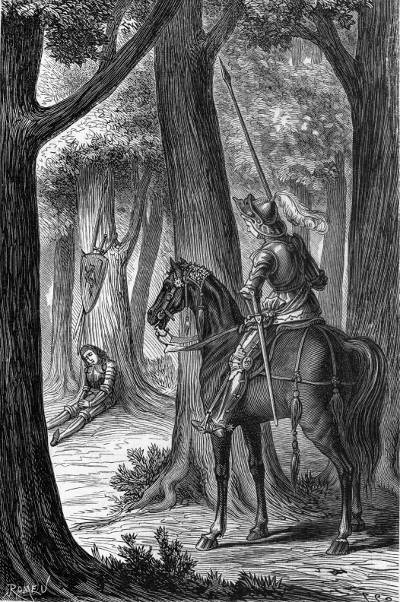
Second installment and I am noticing a pattern. Introduce knight. Make the knight fight. Put knight in hole. Introduce another knight or switch to one you already had in a hole. Rinse and repeat. It’s a neat formula. I can see why the book’s been so popular.
This chapter has a lot of that. It also has wizards, sprites, dwarfs, and a winged horse. A veritable monster manual of stuff.
So strap on your sword belts and let’s go!
Rinaldo and Sacripante are getting ready to duel. The cause? Angelica (and the fact that Sacripante is on Rinaldo’s horse):
“Let us then have recourse
To combat, to decide which of us is
More worthy of the lady and the horse.”
Lady? Horse? Same same.
So the two knights hurl themselves at each other. Rinaldo on the ground, Sacripante on a horse. Except it’s Rinaldo’s horse, Baiardo, and refuses to harm its master. Sacripante dismounts and now they hurl themselves at each other with all their fury. There’s lots of clashing. Rinaldo’s sword is named Fusberta. Sacripnate’s shield gets smashed and his arm broken. Angelica sees Rinaldo is about to win and does what she does best: hightail it out of there as fast as she can and make straight for the forest. In there because the wilderness is a wild place where anything can happen, she promptly finds a hermit who turns out to be a wizard and kindly deposed to her.
“As soon as the fair damsel he had seen
Approaching him, though weaker than of yore,
That organ, by such tender beauty spurred,
With warmth of feeling and compassion stirred.”
(Ariosto’s talking about the hermit wizard’s heart you pervos.)
The wizard throws his lot in with Angelica and goes with her to the nearest port. He also conjures up a sprite to go distract the still fighting Rinaldo and Sacripante. The sprite takes on human form and tells the knights that they have no reason to fight since Angelica’s gone to Paris with Orlando. If they hurry though it’s possible they could catch them. The knights feel like fools and quit the field. Rinaldo reclaiming Baiardo the Horse and we get a bit then about how great Baiardo is. Smart too. Except not this time. Baiardo falls for the sprite’s trick as well. When they get to Paris, they find no Angelica there only King Charlemagne and he’s preparing for siege. Rinaldo’s quickly ordered off to England on a diplomatic mission. Rinaldo set off and puts to sea where a storm promptly starts, and as the waves mount and threaten to sink the ship Ariosto says “Enough of this guy, let’s talk about that lady knight Bradamante.”

Bradamante is Rinaldo’s sister and equal in power, courage, and virtue. I don’t know the name of her sword or horse… yet. She’s in love with and loved by Ruggiero one of the greatest knights in the African army. I suspect we will see more of him later when someone else gets put in a hole. As it is Bradamante finds another knight looking doleful. She asks what’s wrong and the knight tells a tale of how he and his girl were riding along when a knight on a winged horse flew down and stole his girl. He tried to fight the guy, but he was too fast. Now the knight’s girl is locked up in yonder castle and there’s no way to save her. Already the knight told some other knights (Gradasso and Ruggiero) and their dwarf buddy (name as yet unknown) about the flying menace (name also unknown at the moment) and those guys said they would take care of things, but sadly the flying knight kicked their asses (he has a shield that shoots energy beams by the way) and kidnapped them too. Woe. Woe. Boo hoo.
Being a hero Bradamante’s ready to set off and fight this flying menace. The knight agrees to be her guide. But wait! What’s this the knight is not who he claims! He is Pinabel the Maganzan and he doesn’t have good intentions.
“Named Pinabel, of all true knights the foe.
Born a Maganzan, he obeyed no laws
Of chivalry, and of that breed accurst
In acts of treachery he was the worst.”
The two set forth towards the castle, but on the way the envoy from the first canto shows up and tells Bradamante that she’s needed in Marseilles. Pinabel seethes, and Ariosto explains how there’s hatred between the two families. He gets so vexed that they soon get lost in a wood. There after some maneuvering Pinabel spots a ravine and decides it’s as good a place as any to do away with Bradamante. He tells her a story about a damsel trapped in the hole and convinces Bradamante to climb down there. Except when she does, he cuts the tree branch they’re using and lets her drop.
“And how she later fared I’ll later say”
Next week… new knights? New horses?
Orlando Furioso, Canto I

Welcome to this year’s self-imposed task!
Feel free to occupy yourselves as you see fit!
As mentioned before, this year I’ve decided to read Orlando Furioso, the 16th century over-the-top chivalric romance by Ludovico Ariosto.
Who’s that?
Dante lived from the 13th to 14th century. Chaucer in the 14th century. Ariosto lived from the 15th to 16th century. He was a contemporary with Erasmus, Martin Luther, and Machiavelli. So that’s a thing to remember: While princes learned to murder and terrorize, and Catholics and Protestants murdered each other, they all relaxed and entertained themselves with chivalric ideals and heroic deeds. The poem was his gift to his patrons, the ruling D’Este family of the city Ferrara. But you can read all about that on Wikipedia.
So what is Orlando Furioso?
It’s a mess. It’s a book about knights fighting each other with dozens of named characters who ride dozens of named horses and carry dozens of named swords.
Your typical fantasy novel then.
It’s also the sequel to a book I haven’t read called Orlando Innamorato by another guy, so it starts right in the middle of the action with people running around already hating each other.
Of ladies, cavaliers, of love and war,
Of courtesies and of brave deeds I sing…
In times of high endeavour when the Moor
Had crossed the sea from Africa to bring
Great harm to France, when Agramante swore
In wrath, being now the youthful Moorish king,
To avenge Troiano, who was lately slain,
Upon the Roman emperor Charlemagne.
That’s the big picture, but behind it is Orlando, the greatest knight in Christendom, being in love with Angelica, the pagan princess. She hates him and fled to Cathay where she married the king, Ruggiero. This made Orlando mad (hence the Furioso) and he has abandoned Charlemagne’s cause to pillage the land. Another knight, Rinaldo, then fell in love with Angelica. And to keep everyone in his army, Charlemagne had Angelica captured and imprisoned, figuring to award her as a prize after the battle. Except the Saracens (fugg, am I going to have to write this word all year?) win the day and Angelica seizes her chance and escapes.
She, who was promised as a victor’s bride,
Into the saddle leapt and straight away,
Choosing her moment well, set out to ride.
While everyone is a dick, she must rely on cunning to get away from all the knights that would capture her. And have no doubt most of these knights are eager to assault her.
These guys go on and on about purity and the beauty of virgins, but are quick to get to the assaulting when they see any woman. Angelica realizes she needs a protector and finds a Saracen knight she recognizes, Sarcripante (and yes he’s in love with her too), and decides to manipulate him.
How, by her charm, her servant she can make him,
And then, ungrateful, afterwards forsake him.
Unfortunately, Sacripante figures he needs to strike now and take the opportunity to commit the “sweet assault,” but before he can do the deed he hears the drumbeat of horse’s hooves and knows another knight is nearby. More eager to make war than “love” he rides off to find the knight. This knight is dressed in snow white armor and seems to be a formidably built man. Soon the two take to jousting and Ariosto brings the action.
The mountain trembles, as the knights engage,
From its green base to the bare peak it rears.
And well it is the haubreks stand the test,
Else would each lance be driven through each breast.
Both horses fall, but the white knight’s rises again. Sacripante, pinned beneath his dead horse, watches as the white knight rides away. He climbs free, unwounded, save for his pride. Angelica saw the whole thing and he’s ashamed. An envoy rides by and Sacripante asks who was that white knight, to which the envoy says it was Bradamante, as beautiful as she is brave.
To be unseated by a woman!?!

Sacripante’s shame intensifies. Angelica and he ride away, his ardor much cooled. After a bit they find a war horse roaming free. Angelica recognizes it as Baiardo, Rinaldo’s horse, and hops into the saddle. Then she spies Rinaldo. And he espies her, and of course he’s in love with her and she hates him, but there she is on his horse with some knight.
And that’s where it ends.
Next time, Sacripante and Rinaldo start with the “come at me bro”.
* For the sake of proper record keeping all the quotes come from the Penguins Classic edition translated by Barbara Reynolds. And the illustrations come from the Spanish edition over on Project Gutenberg.
Red Spectres 11: Man, Rat Swap Souls! Murder Ensues!
Hello,
Here we are with the last story.
It’s been a fun trip. And the last story is a classic of the weird tales type. Not quite soul juicing, but its next door neighbor: soul-swapping.
“Professor Knop’s Experiment” by Pavel Perov (1924)
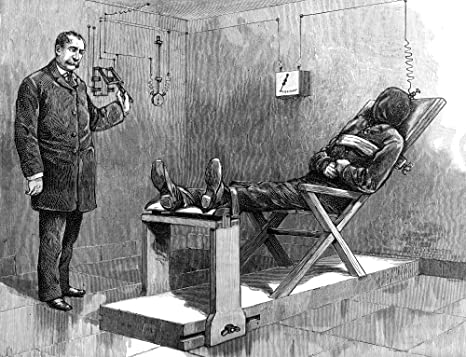
George Gibbs is a criminal awaiting execution for murder in Sing-Sing. He’s approached by one Professor Knop who asks if Gibbs would like to take part in an experiment. What kind of experiment? The soul-swapping kind! And so Professor Knop gives a very long involved bit of technobabble on polarized soul particles and swapping them between bodies, and how he’s only done it to animals and wants to test it on humans now. Gibbs figures he has nothing to lose and agrees to take part in the experiment. His one cause of concern is the fact that the Professor intends to swap his soul with that of a crazed rat. “Don’t worry,” Knop says. “I’ve done it to the rat a dozen times before.”
And so, the stage is set for our inevitable conclusion.
Gibbs’s soul gets swapped into the rat. The rat’s gets swapped into his body. Knop is delighted, and all for a moment looks like it’s going well. Except for the simple mistake that Knop forgot to tie Gibbs’s body down. The rat wakes inside the man and proceeds to beat the professor to death. The cops bust in then, see the raging Gibbs, and proceed to shoot him to death. Of course, the rat with Gibbs inside it tries to stop the cops and gets shot to death too. And there you go.
The End.
Some of you might remember the first soul-juicing story I wrote about here, Greye La Spina’s “The Remorse of Professor Panebianco.” This story is very much like that, if maybe with a veiled critique of the Revolution. You think you can make unintelligent beasts into men with the flip of a switch? Perov’s story would’ve sat well alongside a lot of those early Weird Tales stories. And who knows maybe some work by him did. The brief author biography in Red Spectres says he left Russia in 1910 and lived much of his life in the USA. I’d certainly enjoy reading more by him.
And so we’ve reached the end of Red Spectres: Russian Gothic Tales from the Twentieth Century. It’s definitely a fun collection and worth tracking down. As for what’s next I don’t know. There will still be patreon updates, along with the occasional post on this site. Those will likely be RPG related. As for next year? Well, that’s next year.
I hope you have enjoyed some of these posts. If you can, please consider supporting me on patreon. You’ll receive PDFs of Mysthead, my RPG fanzine, and other goodies as I make them.
As always, stay well.
RED SPECTRES 06: YOU HAVE REACHED THE WRONG SPIRIT

Here we are with our second foray into Mikhail Bulgakov.
He’s certainly the most pulpy of the writers we’ve encountered so far. If he had managed to emigrate to the UK (he was close after the Russian Civil War but typhus prevented it), I believe his literary output would have been colossal and made him better known. This one is short and wry with tongue firmly in cheek.
“A Séance” by Mikhail Bulgakov (1922)
Various aristocrats are meeting for a séance. All formerly posh, they’re now living in dingy apartments as they come to terms with Communism. Despite that, they stick to their flirty Liaisons Dangereuses games and polish their former glories. Tonight’s a sort of grab bag of characters out of a much diminished social circle. And there’s lots of chatter of how scary to make things. All this is depicted in brusque choppy fashion.
Meanwhile, their servant girl has no idea what to make of things. She watches as windows are covered, lights are turned out, and strange sounds start occurring. Eventually she gathers up her courage and starts peeping through the door to where the former nobles are gathered. She overhears talk of emperors and how the spirits give Bolshevism three months at best. All this is unnerving for her, so she goes downstairs to her friend’s apartment and tells her all about these wacky people she works for. As she does so she’s overheard by an outlandishly dressed soldier fellow who follows her back upstairs to see what apartment she works in and he then goes off to tell someone who tells someone. Before long the aristocrats hear a loud banging on the door, and at first they think it’s the spirits. But, it’s not. It’s the Cheka and they want to see everyone’s papers please… The End.
This story has the barest hint of the supernatural about it. That outlandishly dressed soldier fellow? Is he human or supernatural? Regardless of what he is, he does his duty informing the authorities of the strange doings in the apartment building. And the squalor is played up to point at an absurdity in the aristocrats. They’re playing old games from a world that’s gone, unaware that the new world has new games and they’re fast approaching the door. You can laugh at them, but it’s not a laugh without despair.
Next time, a story by a writer I have a collection of but haven’t read.
What?
You don’t have half-a-dozen books like that on your shelves?
WOMEN OF WEIRD TALES 13: THE ANTIMACASSAR

Macassar oil. Do you know what that is?
Macassar oil was a hair product that became popular during the 19th century. It was made from coconut and palm oils. Everyone back then wore so much of it that the fabric headrests of chairs would get a worn polish on them. This was unseemly in the eyes of society. Enter the antimacassar: a thin, decorated bit of cloth you could slip over a chair’s headrest to protect the fabric. If you’ve ever ridden on a bus or train, you’ve likely encountered an antimacassar. I knew none of this before reading this week’s story. Now I do and so do you.
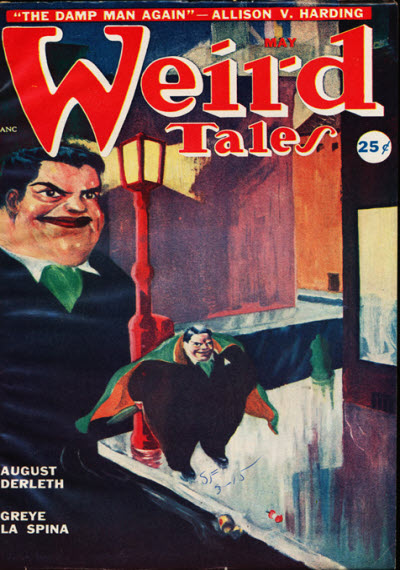
“The Antimacassar” by Greye La Spina (May 1949)
This is a decent story and one that makes for a good ending to the collection.
Our heroine, Lucy Butterfield, works for a textile company. She’s on the road showing samples, but really she’s trying to find her missing friend, Cora Kent. Cora was the sales representative before her and went missing somewhere in the back country. Our heroine has tracked her to a remote farm where a Mrs. Renner and her handy man live, along with the sickly Kathy Renner who is twelve years old and confined to bed.
Mrs. Renner claims not to have seen Cora, but Lucy suspects they know something. It was there that Cora made the strange antimacassar with its pattern of circles and snakes that puzzled Lucy so much to send her out here. She lingers around the farm maintaining the pretense that she’s simply the road rep for a fabric company. Soon Kathy’s whining that she’s hungry and there are strange sounds at Lucy’s door. Then the nightmares begin of a monstrous child that feeds on her.
Lucy finds herself growing weaker, and slowly she realizes she must leave, but Mrs. Renner keeps sabotaging her attempts. In between all this Lucy and Mrs. Renner discuss needlepoint and fabric. Finally, the monstrous child appears. What a shock! Kathy is a vampire! But fortunately, the heroine’s strapping lad of a boyfriend, Stan, shows up right there and kills the monster child. Lucy sent Cora’s strange antimacassar to his mom and right away he realized the snakes and circles were an SOS message. What’s odd is no one is shocked by the vampirism. Apparently, everyone in this world must be a Weird Tales fan and expect such things. The End.
I dug this story. It had a nice mix of the morbid and the mundane. And enough of my family worked in New England’s textile industry, so it was neat to see something similar here. (It actually takes place in backwoods PA, but I imagine the two are similar.) And while the heroine is ultimately saved by a strapping lad, she is the one throwing herself into harms away to rescue a friend and do the detective work. I might have wanted the collection to end with more Everil Worrell, but this was not a bad place to finish. From here it’s easy to see Shirly Jackson and Stephen King on the horizon.
And that’s it.
We have reached the end of The Women of Weird Tales. I hope you all have enjoyed it. The collection is great fun and I recommend it. Maybe if enough people buy it Valancourt will put out a fancy Everil Worrell collection!
I’ll post my top 5 favorite stories over on my patreon. If you’ve enjoyed this series, why not consider becoming a patron. Or not. You do you. You can expect the Red Specters reviews to start sometime in June.
Stay well!
THE WOMEN OF WEIRD TALES 12: IT’S YOUR BOI AGAIN… THE GREAT GOD PAN!
This is it.
The penultimate story. And it’s a story that asks an important question: What if Weird Tale writers didn’t have so many sex hang-ups?
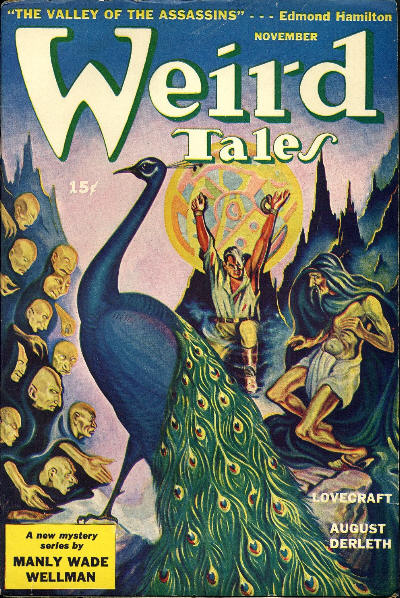
“Great Pan is Here” by Greye La Spina (November 1943)
Our narrator’s driving along after having five cocktails with his cousin Cecily and their chaperone, Aunt Kate. They are on their way to the symphony. Now Craig, our narrator, has the hots for cousin Cecily and fears that her upbringing under the old-fashioned Aunt Kate is making her too reserved. He wishes something would wake the girl up to the world of love and emotions. Especially his emotions for her. Then side the road he glimpses a pan pipe. It’s just lying.
Was it real? Was it not?
He hesitates to bring it up. Aunt Kate hates missing the opening movements of a symphony. But he does, and no one believes him.
Later back at home our narrator drinks some more and appraises the effects of moonlight on his garden. He’s got a new nymph statue he brought back from Italy, and it’s pretty sweet. Musing such, he’s surprised when he glimpses someone in his garden. He goes to investigate and finds no one but hears the faint piping of a pan flute.
Was someone taunting him?
But no matter how desperately he searches he can’t find anyone, so eventually he goes back to the house.
The next morning Cecily’s dressed for yachting and our narrator’s thinking thoughts of love and goddesses and basically being a lusty horndog except in an Edith Wharton sort of way. He’s about annoyed when she suggests inviting along a friend, Tom Leatherman, they bump into. They all pile into the boat and our narrator fumes as he gets the yacht going. Meanwhile Tom’s talking about the pan pipes he found on the road the day before. Cecily hears that and apologizes to our narrator for not believing him the day before. Craig accuses Tom of sneaking into the garden and playing the pipes. But Tom denies it was him. Then Cecily startles everyone by saying she heard the piping too, and if it wasn’t Tom who was it then?
If only they had read the title of the story they are in.
There’s more sailing. More brooding over pan pipes. More talk of strange notes being played in the air. They go back to shore and ditch Tom Leatherman. Then Craig and Cecily go in the garden for a picnic. They’re starting to warm to each other. The mystery of the pan pipes has made a bond between them. But as they walk they find they’re not alone in the garden. A strange man is there.
Strange and foreign looking.
It’s the Great God Pan.
He then gives them the pitch. He’s an old god making his way in the new world and he’s looking for gardens that bear something of the old ways about them. Craig’s garden with the imported nymph statue is one such place. And Pan wants it. In exchange he offers to give Craig what he desires (Cecily).
This is where something interesting happens. First there’s talk of haggling and buying affection with gold, but Craig says that’s not how it’s done these days. Now it’s love that seals the deal and love that is exchanged freely between individuals. Cecily needs to give her consent in order for there to be a deal. And she does much to Craig’s delight.
Pan’s pleased and says he’ll be back later that night.
Now Craig and Cecily start to wonder what exactly they’ve done. They’ve invited an old god into the garden. That’s not something you can just admit to the yacht club. However they do decide to get married and when back inside they tell Aunt Kate and she’s happy, but still doesn’t want them to be alone together.
Night arrives. Time for bed. Once the house is asleep Cecily and Craig sneak out into the garden. The music starts. The Great God Pan is there.
Ecstasy, dance, sex, etc.
And it was all okay.
I’m not quite certain at the level of consanguineous between Craig and Cecily. I’m thinking they’re like third cousins, which strikes me as weird but not awful. There’s a bit more the next morning where Aunt Kate mentions the nymph statue seems to have lost her scarf, but that’s pretty much the end. But overall, nothing awful happens.
At least nothing awful relative to your views of conjugal relations between distantly consanguine relatives and Paganism taking root in the USA. If you’re cool with all that this story is simply The White Goddess meets Edith Wharton. Premarital sexy times are had and no one is hurt who isn’t already more than a little bit dead inside, and they’re only hurt by having a bad night’s sleep.
La Spina likes her purple prose and manages to dress all her words in such a way that they wear diaphanous gowns. Sure, it reads a bit stilted and melodramatic, but it’s not without its charms. And the sex positivism and enthusiastic consent ideas are refreshing. Like why would I be outraged that two young adults who are obviously into each other sleep together? Is it because they do it under the influence of strange rites conducted by a swarthy foreign man? That’s silly.
Of course, it’s possible that I missed some sinister element in the story. But I don’t think so.
Next week, our last story from The Women of Weird Tales. It’s another from Greye La Spina, and it’s called “The Antimacassar”.
Until then stay well.
WOMEN OF WEIRD TALES 10: YOU SAY UBIK. I SAY UBIQUE.
We have entered the Virgil Finlay era. Look at this cover. Isn’t it great?

Imagine seeing that on a newsstand. I am going to go out on a limb and assume the issue had a reprint of Everil Worrell’s “Vulture Crag” in it. So, technically, this is our second story that received a cover illustration. It’s just not the story we’re here to talk about right now.
“Web of Silence” by Mary Elizabeth Counselman (November 1939)
The scene is Everytown, USA. Sinister things are afoot. Threatening letters have appeared. They are triangular. The script oddly “foreign”. The letter writer, a Dr. Ubique, foretells disaster on a given day at a certain hour. They demand money. At first the town leaders laugh this off as a harmless crank. But then the day and hour arrive and the disaster strikes: Silence. Silence so deep so impenetrable that the whole town comes to a standstill. And that’s the story. What we read is the day by day as people try to go about their lives in the zone of silence. There are tragedies and misunderstandings, comic scenes, and lots of confusion. In a neat touch outsiders start visiting the town as tourists and the highways get gnarled up as people travel into and out of the “sound limit”.
This is one of those odd disaster stories where something bad happens, but it’s not too bad and no one is to blame really. Even when Dr. Ubique reveals himself (a foreign scientist), he admits his letters were all a prank. He’d learned about some rare metals beneath the town and predicted how they would interact with certain approaching environmental conditions (cosmic rays from a nova). He wasn’t the cause, but only the observer. So you can’t blame him. Here’s your money back. Thank you very much and sorry for the trouble.
Overall this story’s fairly ho-hum and never goes full throttle. I mean “The Week It Got Really Quiet” isn’t much of a catastrophe, is it? But what it does depict is some of that 1930s sensawunda. The world is full of scientific marvels and natural laws we barely understand, and they are occurring directly beneath our feet and above our heads. Our Dr. Ubique is both mad scientist and harmless eccentric. In the end nothing will be irreversibly broken and everything will be okay.
Honestly, I felt a bit cheated.
If you’re a Philip K. Dick fan your eyes will likely have lit up at the name of Ubique. Not that there are many connections between this story and Dick’s novel Ubik, but it shows he had no problems reiterating on decades older work. What I am saying is no one should feel ashamed for riffing on old stories. Philip K. Dick did it all the time.
Next week?
A story I have absolutely zero memory of reading. I must have, because I finished the book, but what this particular story was about I have no clue. I guess we’ll find out next week, won’t we?
THE WOMEN OF WEIRD TALES 09: STATUES, BIG AND BLACK
We have entered 1930s era Weird Tales. Gone are the fever dreams of Everil Worrell. The next set of stories have a much different and more recognizable tone. In a less charitable mood I might even describe them as “meh”.
However, the covers, as you can see, remain saucy.
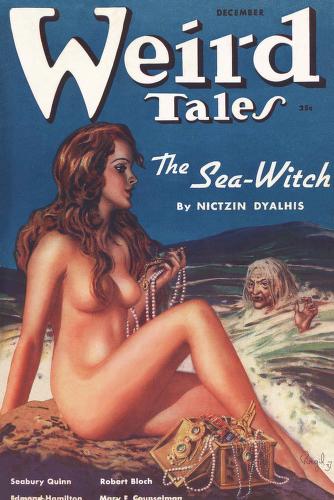
“The Black Stone Statue” by Mary Elizabeth Counselman (December 1937)
Dear sirs,
My name is Very Successful Artist. I am writing this first hand account of how I became so successful. It all started in my rooming house where I encountered my long missing friend, Famous Explorer.
Now, as you can imagine, I was surprised to find Famous Explorer in such a low boarding house with such a meddlesome landlady. She spoke in this dialect of English that uses many apostrophes when I transcribe it. Overall, she was awful and wouldn’t even allow her boarders to keep a radio. I bring this up because there was a high-pitched sound coming from Famous Explorer’s room. Now I managed to corner my friend and through some arm-twisting I got him to relate his story. I will now pause my first-hand account to let Famous Explorer give his first-hand account of what happened.
Hello, my name is Famous Explorer.
I was deep in the jungles of South America. It was exactly like all those pictures of jungles people show in those movie serials. One day, my assistant, Ethnic Stereotype, went missing and I had to go find him. When I did find him it was in this strange part of the jungle where everything had been transformed into vividly detailed black stone. Needless to say he had been transformed as well. Poor, Ethnic Stereotype. Now it turns out in this jungle was this very beautiful snail-slug-orchid-thing and it turned everything it touched into this black stone. It also makes a high-pitched sound. Believe you me, it took all manner of derring-do to not get turned to stone myself, but I managed to capture the thing. Now I’ve brought it back to civilization where I plan on exploiting the thing for industrial purposes.
Oh noes!
Very Successful Artist has pushed me on top of the snail-slug-orchid-thing. I am now dead.
Sadness.
Yes, that is correct sirs, I, Very Successful Artist, turned Famous Explorer into a statue and stole the snail-slug-orchid thing. I did the same to the landlady and a bunch of other people. All my statues have been created using the snail-slug-orchid thing. My whole career is a sham. I am going to throw the snail-slug-orchid thing into the ocean and kill myself now.
Thank you and goodbye.
Sincerely,
Very Successful Artist
###
And there you have it: “The Black Stone Statue”.
It was okay, very much the ur-cliché of a cliché. I feel like this strange creature that transforms/mimics things was a staple in a Philip K. Dick’s work. I don’t know if he took the idea from this Counselman story, but it’s not hard to imagine that he did. Which is fine. He ran with it and made it his own.
Next week?
A web of silence.
 Yesterweird