From Italo Calvino’s “Invisible Cities”
“Also in Raissa, city of sadness, there runs an invisible thread that binds one living being to another for a moment, then unravels, then is stretched again between moving points as it draws new and rapid patterns so that at every second the unhappy city contains a happy city unaware of its own existence.”
From Morality Play by Barry Unsworth
“Afterward I remembered these things very clearly, with that longing we feel sometimes to recover a state of life that we have lost for ever, though perhaps that we have lost it is all its value.”
Some Lem
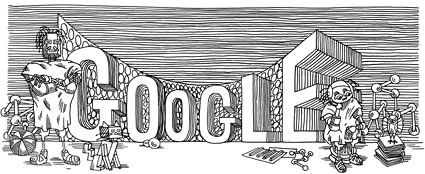
Google keeps a gallery of all their homepage “doodles” from around the world. I hadn’t seen the Stanislaw Lem one (above). It’s even interactive, which is fun since deskwarming and all. Not that it’s appropriate for today, but we take what we can get in this world.
“The reason, if I can put it this way, is simply because it would be awkward for me to get into my bed of creation wearing heavy boots of realism. Solaris is about love and the mysterious ocean, and that is what is important about it. As to how the protagonist actually got to the planet, I pretend that I do not know.”
– Stanislaw Lem
Three Reasons Why People Should be Reading Steve Aylett
1. A shop with its own weather, the Thousand Spiders was a place of gut-turning symmetries and the slap of palpable etheric manipulation. In fact it was impossible to tell whether you really wanted to buy what you bought there.
2. In the past everyone had feared Dumbar because his head was actually a chrysalis for another animal. In recent times his face had been almost transparent and they could see something bustle and shift behind it. Finally he’d stopped short in the middle of a conversation and opened his mouth, from which a bunch of fiddling spider legs fanned. Everything else followed and he was speechless and shaking, the only one without a scream to offer as the dog-sized bug quivered into a corner and stayed there to dry off.
3. ‘Oh I heard the voice of God once,’ Edgy told him. ‘Yeah, I was at a buffet, you know? And I was going for the chicken, and this voice from above said, “Take the ham.” So that’s what I did.’
‘Take the ham? And that’s the only time God ever chose to give you advice?’
‘Correct. I can only conclude that in every other area of my life I’ve been right on the money.’
– All from Only An Alligator by Steve Aylett
The Joke by Milan Kundera
This one got passed to me by someone in Korea. My wife is a fan of Kundera. Or was, before I ruined her taste with comic books and Fritz Leiber.
The Joke details several “jokes”, none of which are the haha kind. The first one is a postcard written by Ludvik Jahn when he was a student that caused him to be sentenced to the coal mines. This event propels the plot in so much as the plot is about Ludvik’s quest for revenge fifteen years later. In the ways his plan gets fulfilled and in the ways others react to it provides the rest of the “jokes”.
“When it is postponed, vengeance is transformed into something deceptive, into a personal religion, into a myth that recedes day by day from the people involved, who remain the same in the myth though in reality (the walkway is in constant motion) they long ago became different people: today another Jahn stands before another Zemanek, and the blow that I still owe him can be neither revived nor reconstructed, it is definitely lost.”
Ludvik’s a rather unpleasant and bitter guy, but in him we can see a thwarted hero. His path suggests an anti-bildungsroman where the youth does not mature by overcoming adversity but instead grows cynical when he encounters the injustices of the world. For awhile I was at a bit of a remove while reading it, waiting for it to transcend its “Soviet-style bureaucracies are never good” message. But by its end The Joke is less about any particular course of action or desire the characters have and more about the way history (and historic events) undermines all our expectations — and discovering redemption despite this. It’s a great book as long as you don’t mind your existentialism mixed with a blend of male chauvinism.
More From Disorienting Encounters
“There is no better way of obtaining useful information than by mixing with people. According to a wise saying of the ancients: “The eye never tires from seeing, nor the ear from hearing.”
Therefore, I decided with the help of God to blacken these pages with what I saw and heard during this voyage, be it clear or obscure. For I am but a woodgatherer of the night, the one who lags behind, a horse who is out of the race.”
– Disorienting Encounters: Travels of a Moroccan Scholar in France in 1845 – 1846. The Voyage of Muhammad As-Saffar
Lolly Willowes by Sylvia Townsend Warner

Here’s the first read for 2012: Sylvia Townsend Warner’s Lolly Willowes. Yup, it’s another New York Review Book and it hasn’t shaken my conviction that all of their books are great. Warner combines the perceptiveness of Jane Austen with the supernatural touch of Shirley Jackson.
Laura “Lolly” Willowes is a single woman in the early 20th century, and the novel concerns her spiritual renewal late in life (well after she has been consigned to the role of spinster aunt by her family) when she becomes a witch of the Margaret Murray type. It’s a slow but fascinating novel, off-kilter in its meandering, but focused in its observations even though the plot really never strays too far from “spinster aunt sells her soul to the devil and lives happily ever after”.
By its end the ground is so well laid that when Warner kicks off the braces and lets fly with some social critique it’s honed to needle sharp perfection.
“’They say: ‘Dear Lolly! What shall we give her for her birthday this year? Perhaps a hot-water bottle. Or what about a nice black lace scarf? Or a new workbox? Her old one is nearly worn out.’ But you say: ‘Come here, my bird! I will give you the dangerous black night to stretch your wings in, and poisonous berries to feed on, and a nest of bones and thorns, perched high up in danger where no one can climb to it.’ That’s why we become witches: to show our scorn of pretending life’s a safe business, to satisfy our passion for adventure.”
Also as a slight aside since I read a lot of weird late Victorian horror fiction, this book’s the perfect antidote to the veiled puritanism in Machen’s work. His women characters are so often “corrupted”, either inherently or by circumstance, that it’s fun to read Lolly Willowes and have that paradigm thrown on its ear. The bachelor nephew, Titus, who would be the hero in a Machen novel, here gets consigned to the role of villain and fool, and the “corruption” Lolly experiences is her hard-earned right to live as she pleases and be respected for it. Bravo for her!
A last point, save the introduction until after you finish the book since it’s one of those that lays out the entire story and, you know, SPOILERS.
From Olaf Stapledon’s The Last and First Men
Olaf on Americans:
“In the Far West, the United States of America openly claimed to be custodians of the whole planet. Universally feared and envied, universally respected for their enterprise, yet for their complacency very widely despised, the Americans were rapidly changing the whole character of man’s existence.
What wonder then that America even while she was despised, irresistibly molded the whole human race. This, perhaps, would not have mattered, had America been able to give of her very rare best. But inevitably only her worst could be propagated. Only the most vulgar traits of that potentially great people could get through into the minds of foreigners by means of these crude instruments. And so, by the flood of poisons issuing from this people’s baser members, the whole world, and with it the nobler parts of America herself, were irrevocably corrupted.”
…
“These best were after all a minority in a huge wilderness of opinionated self-deceivers, in whom surprisingly an outworn religious dogma was championed with the intolerant optimism of youth. For this was essentially a race of bright, but arrested, adolescents.”
Sometimes One Even Does It By Oneself
“During their leisure time you will see them promenading on the streets and boulevards. One of them takes his friend, male or female, by the hand and they set out on a stroll, going back and forth with purposefulness as if they had a goal in mind, but their only intention is talk and relaxation. Sometimes one even does it by oneself. They say it is useful for reflection, for revealing hidden thoughts, and for discovering new ways of doing things; and I tried it and it was true.”
– Disorienting Encounters: Travels of a Moroccan Scholar in France in 1845 – 1846. The Voyage of Muhammad As-Saffar
Idle
“There was formerly a capacity for light-heartedness and play which has been to some extent inhibited by the cult of efficiency. The modern man thinks that everything ought to be done for the sake of something else, and never for its own sake.”
-Bertrand Russell, In Praise of Idleness
 Yesterweird