Journey Planet 15
 I have a short piece in issue 15 of the fanzine Journey Planet. Click that, scroll down, and download the free PDF. It’s the “write stuff” issue edited by Lynda Rucker and includes articles by Lynne Thomas, Jason R. Ridler, Kameron Hurley, and plenty of others.
My piece is a dandied up version of this blog post. For the record I’m no longer reading slush in any fashion.
A Month or So Ago
It is frustrating at times because one day you will be reading a book and thinking “This is great – This is the way to do it”, then two days later you’ll be reading another book and it’ll be doing the exact opposite thing, but you’ll think the exact same thing.
When faced with two opposite truths the issue is no longer to find the fault in one, but to decide between them. Which path will lead you to the place you want to go.
Rainy Saturday
There will never be a rainy Saturday afternoon long enough for all the movies that require a rainy Saturday afternoon to be fully appreciated.
The Other Side of McMedieval Feudalism, or The Use of Mythic Distance in Malory’s “Le Morte D’Arthur”
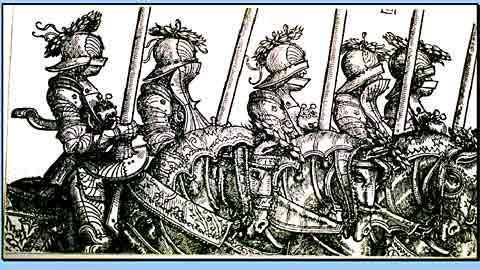
So that fascinating thing I hinted at about the setting in my last post about Le Morte D’Arthur – it’s totally generic McEurope, but instead of this being a design flaw, it’s a design feature.
Actually calling it McEurope is too specific. It’s more McMedieval Feudalism seen from the top without ever looking down. It’s an aristocracy divorced from all other social classes with an endless supply of weapons and armor to fight with. You have to at least enjoy that stuff as aesthetic trappings without any attendant realism. Only once does someone go to town and see a craftsperson to get a thing fixed. That’s your realism. Peasants hardly ever appear in it, and knights apparently have nothing better to do than stand all day beside bridges challenging whomever happens to walk by. “None shall pass”, etc.

What locales there are all blend together. Bridges, cloisters, and wells with maidens (or knights) weeping beside them lend some decoration to the otherwise indistinguishable setting. There are castles, and outside every castle is a forest. Inside the forest adventures happen.
But I said this is a feature rather than a flaw. What makes it fascinating is how quickly bright sanitized McMedieval Feudalism can become weird foreboding mythic id-laden fairyland. The one rule is when you go into the forest stuff happens to you. That stuff can be the frat-house jousting (with accompanying sides of homoeroticism and misogyny), or something a lot weirder and subconsciously ripe. It’s no surprise that “the forest” gets transformed into “the wasteland” during the Grail Quest.

What to make of this? On one hand the setting is so bland and divorced from reality as to be nonsensical. On the other hand that blandness has an advantage when telling a story and playing with archetypes, especially because the bland is divided in half, a mundane world and its fantastic reflection, and the archetypes are never quite certain when the one will shift into the other. Not just this, but any deviation from the uniform setting stands out.
So it’s okay to be bland as long as it’s a conscious choice. Use it to your advantage. Dive deep and swim in the dark waters waiting beneath the bland’s placid surface. Find those pearls waiting down there along with those toothsome beasts. What you find might be wonderful or it might be ugly, but it won’t be bland. That’s for certain.
Konk!
 So I get these awful headaches. I don’t know what causes them. They basically creep up on me and floor me for a day or two. This weekend has been one of those instances. I slept twenty hours on Saturday and hardly moved from the bed today. My doctor (God bless him and his luchador mask) told me not to take any caffeine or alcohol when I get them, so I’ve tried to stick to that.
But, jeez, what a drag.
Anyway, enough of my whining, here’s Lewis Carroll from his pamphlet Feeding the Mind:
“To ascertain the healthiness of the mental appetite of a human animal, place in its hands a short, well-written, but not exciting treatise on some popular subject—a mental bun, in fact. If it is read with eager interest and perfect attention, and if the reader can answer questions on the subject afterwards, the mind is in first-rate working order. If it be politely laid down again, or perhaps lounged over for a few minutes, and then, ‘I can’t read this stupid book! Would you hand me the second volume of “The Mysterious Murder”?’ you may be equally sure that there is something wrong in the mental digestion.”
How To Read
Back in the good old bad old days I worked with a guy who would take summers off to go work in Alaska as a hunting guide. He’d return in the fall with an assortment of wilderness stories. One of them was about when the other guides and he all got stuck for a week in the back country waiting for the plane to pick them up. They ended up having to trek miles to another pick up site and wait for the plane there. On the way one of the guys dropped his book in the river and wound up with nothing to read.
For a week they were stuck in tents waiting out the rain and waiting for this plane to show up, and the guy had nothing to read. So he started reading the ingredients listed on the soup cans. Over and over again. By the end of the week he had memorized them and could rattle them off in a litany. Chicken noodle. Minestrone. Whatever they had.
That’s how to read.
Desperately. Obsessively. Like your life depended on it.
To Trunk Or Not To Trunk
Reasons to trunk a story:
- If it were published you wouldn’t tell anyone and you’d hope no one would read it.
- You know it’s not together yet. Parts might be working, but parts aren’t. It will simply accrue rejections and thereby limit its markets for when you do figure it out in the future. Put these on the trunk’s top shelf. Months from now you might know exactly what needs to be done with them.
- You’ve seen hundreds of stories exactly like it in the slush and yours isn’t any better.
- Better a story go in the trunk then e-pub it and guilt all your friends into buying it.
With the caveat:
NEVER THROW ANYTHING OUT.
Likenfreude
Likenfreude: When you recognize exactly which blog post/youtube clip someone’s opinions came from.
This is a working definition and liable to change.
“-Freude” means joy and this feeling isn’t really “joyful”.
Maybe it should be “linkenfreude”.
I’m So Happy. *COUGH*COUGH*
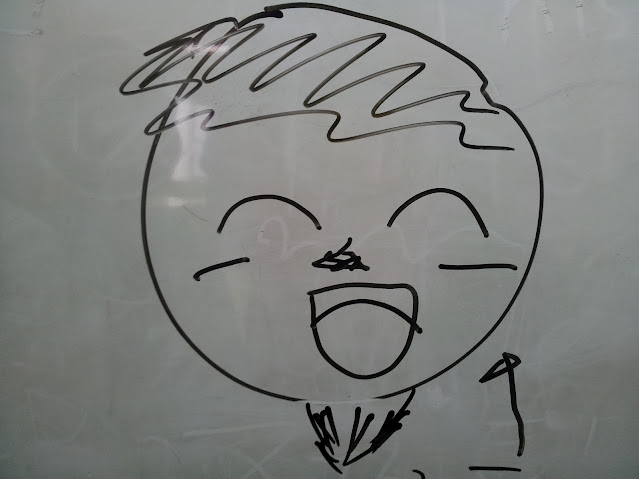
Another portrait by one of my students. Dig the Maynard G. Krebs beard.
Still coughing and limping. I went back to the doctor’s for a check-up. I have another six days in my cast, but he says my ankle’s healing quite well.
From the Ray Bradbury Paris Review interview: “I type my first draft quickly, impulsively even. A few days later I retype the whole thing and my subconscious, as I retype, gives me new words. Maybe it’ll take retyping it many times until it is done. Sometimes it takes very little revision.”
That makes me think a bit.
World Building
I actually can’t stand hyper-real, “vivid” world-building. Leiber names maybe at most a dozen streets in Lankhmar and describes less than half a dozen neighborhoods — I’d be surprised if he mentions more than four neighborhoods.
However I realize I am in the minority with this opinion and wonder if the clotheshorse swordporn I hate so much might stem from audience overlap with the SCA that values that level of immersion.
Remember Lucas’s Law: The Clone Wars were so much better imagined than seen. The job is to write stuff wide enough for the reader or player to get lost in and shape on their own, than to shape it all for them and suck the life out of it.
(from an email discussion with some friends)
 Yesterweird