“Memoirs of Journeys to Venice and the Low Countries” by Albrecht Durer

“Here I am a gentleman, at home a parasite.”
I downloaded this from Gutenberg. It’s delightfully dull — all about buying and selling jewels (for friends and to pay back his own debts), complaining about Italian painters (rascals, all of them, except Giovanni Bellini), worrying about his mom (he was paying her rent as well as his wife’s back in Germany), and admonishing his kid brother (do not neglect your studies). For much of it Durer seems to be balancing his account book. “How many florins did I spend on dinner last night?” Benvenuto Cellini, he’s not. Very rarely does Durer mention art, except in its most mundane obligatory sense: “The German commune hired me to paint an altarpiece. I should be done in a month and should be able to pay you back then.” One month later: “Altarpiece taking longer than expected.” And, if Durer engages in any hell-raising, he’s discreet enough not to write home about it.
But there are bits of humor and Durer’s character, at least as a friend, comes across:
“My French mantle greets you, and so does my Italian coat. It seems to me that you smell of gallantry. I can scent it from here; and they say here, that when you go courting, you pretend to be no more than 25 years old. Oh, yes! Multiply that and I’ll believe it.”
Durer’s now in the Low Countries with his wife and he’s using his prints as money. “Had sumptuous dinner with guildmaster. Must have cost a fortune in florins. Gave him a gift of an Annunciation in thanks. He gave my wife a parrot. Bought cage for parrot.”
Then there are the mundane details that I love: Durer dates his letters by church holiday as well as calendar day; he attempts to describe a parade he saw in Holland in honor of the Emperor… and it’s something else with costumes and each guild, society, and church group putting on their own display and a constructed dragon at the end surrounded by knights and ladies and led in chains.
Definitely recommended for folks into unsexy travelogues and dull time travel (what, you’re not?) and who don’t mind having the occasional eye-glazing moment when Durer gets preoccupied with his accounting.
“Now did I pay Hans a stiver or a florin or a pfennig or a…”
Buy These E-Books



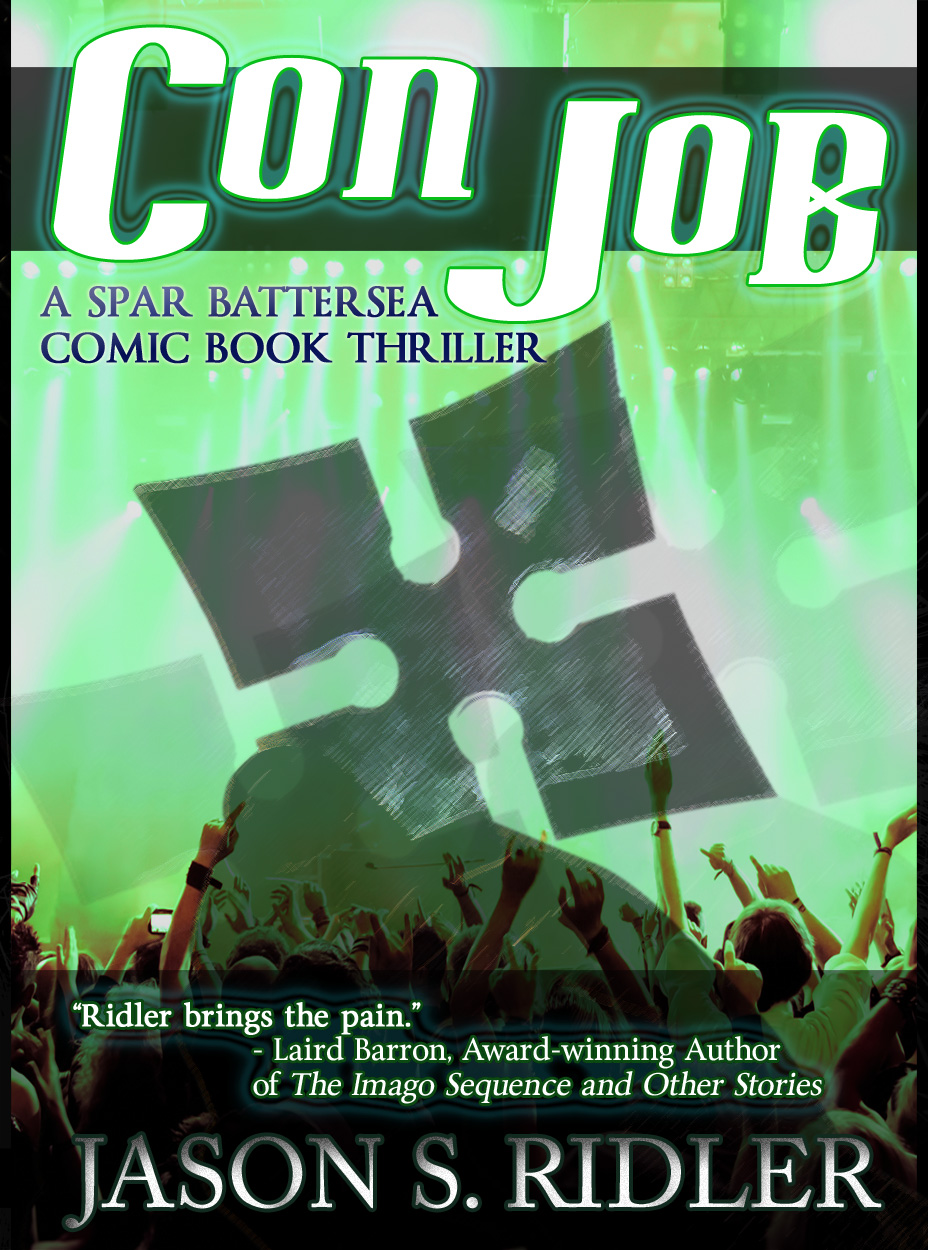
My buddy Jay Ridler has come out swinging this past year with a slew of e-books over at Amazon.
So far I’ve been digging the Spar Battersea novels, the first of which Death Match got described as “a rock ‘em sock ‘em addition to the noir canon. Gritty, relentless, and wry as hell, Ridler brings the pain” by the likes of Laird Barron and “Fast, breezy and barbarous, Death Match is a fine, innovative noir from an exciting new writer. Reading the book is like eating a corn dog while watching a lard fire run through a greasy-spoon, it’s both tasty and nasty” by Lucius Shepard (if you’ve never read his horror/weird/crime novel A Handbook of American Prayer, you should, like, right now).
And the second Spar novel, Con Job, takes place at a comic con… so what are you waiting for! But… among the many good things Jay has done this year my favorite is this Game that goes like this:
New game I’ve invented. If you’re keen, play along!
Whenever you feel the urge to look at X, look at your work in progress instead. +2 ptsWhenever you feel the urge to look at X, start reading a new short story. +1 ptsWhenever you feel the urge to post on X, write 100 new words instead. +5 pts.When you reach 50 points, you may look at X and do what you want with it all day. Then start again!
Spectacles
“He had read endless books, he had digested them, pondered over them. Day by day, year after year, he had turned over all the problems of human beings. Yet there were all sorts of simple things he didn’t know how to do: he couldn’t even walk into an inn and sit down at a table.”
– Georges Simenon, The Strangers in the House
Finished this book this afternoon. I think Simenon’s terrific but he’s one of those authors I can’t read a lot of in one go. Great stuff and he’s writing on all cylinders here, but if I spend too long with his style it becomes so transparent it’s like seeing how the magician does his tricks.
Character-arc spoilers: The novel’s about a drunken recluse. At the end he’s still a drunk, but no longer a recluse. This is something of a happy ending.
One Book Five Covers: Riddley Walker by Russell Hoban
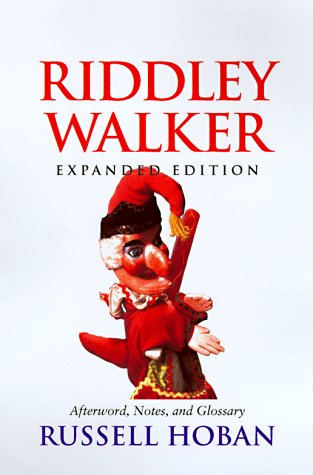
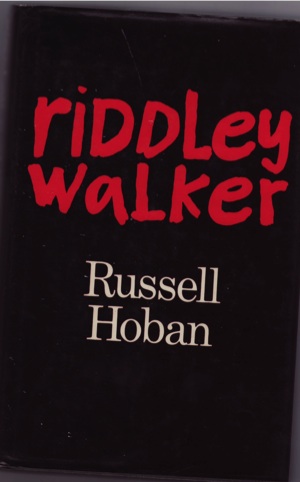
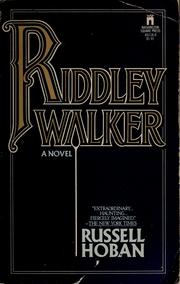

Russell Hoban’s novel Riddley Walker is a bit like Walter M. Miller’s A Canticle for Leibowitz mixed with Anthony Burgess’s A Clockwork Orange. Set in a post-apocalyptic England that resembles the Iron Age, Riddley’s written in this odd, “degraded” style of English that is difficult to parse at first but after a bit takes on a poetic power.
A quote:
“Where ben that new life coming in to? Widders Dump. You know what they ben doing there. It ain’t jus only forming they ben doing there with stock and growings they ben digging they croaking iron. They ben digging up that old time Bad Time black time. Now weare at the las weve come to No. 1 and Brooder Walker. Widders Dump and thats where Aunty come for him. Stoan boans and iron tits and teef be twean her legs. Brooder Walker dug her up and she come down on top of him o yes.”
Another conceit of the book is that puppet shows like Punch & Judy mixed with Medieval morality plays are used by the government to communicate official announcements. Riddley digs up an old Punch puppet and this sets him over the fence and wandering the outside world. Hence the appearance of Punch on two of the covers.
Those two covers at least give you some idea what to expect in the book. The second cover, full of quotes calling the book brilliant and what not, looks more like a back cover, and the third and fourth covers look like in-the-know covers, by which I mean that unless you’re in the know already those covers aren’t going to tell you anything about the book.
Regardless of the cover you find, it’s a great book and worth checking out.
(There’s also this whole theory about how the book inspired parts of Mad Max 3: Beyond Thunderdome.)
One Book Three Covers: Missing Man by Katherine MacLean
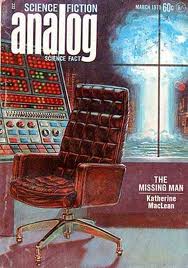
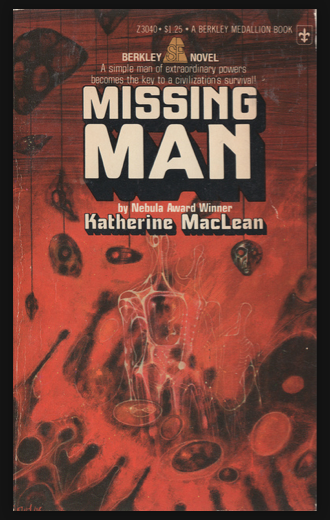

This is one of those books I read about on a blog somewhere discussing “forgotten classics” of SF. The premise sounded neat: a pair of heroes (more psychic EMTs than cops) roams the weird streets of a future New York City that’s fragmented into communes.
The novel began its life as a series of novellas in Analog before going the fix-up route, so it’s no wonder that the Analog cover with its Apocalypse Chair is the most apt, sort of. The second picture is the first paperback novel printing and it’s your standard 1970s SF moodscape, like for real man, without any indication of setting or character. All it needs is a sketchy disembodied head screaming and you could call it Operation: Mindcrime. The next with the black cover is the Prime Books Wildside Press edition that’s in print now and it’s the copy I read, and, well, that’s the dullest of the bunch. It’s a road sign.
All of which is a shame because Missing Man is a fun book. It’s dated for sure, and a bit eyebrow-raising whenever the conflict centers on rescuing someone from a “crazy” ethnic or racial minority, but it’s also weirdly prescient in the way its fragmented NYC resembles the Internet: a world where people have segregated themselves from each other along the lines of their interests and via their computers so they never need to encounter someone who disagrees with them.
Missing Man may be wrong in the particulars and technology of this fragmentation, but I suspect it’s right in depicting some of the results.
Translation Telephone
Jin received her copies of the John Shirley book Rapture that she translated. She wrote a blog post about it. It’s in Korean, but there are pictures.
The reaction from the Korean BioShock community has been interesting. Some people are annoyed that the book doesn’t match the fan-made patch (where one thing named INCINERATE got translated as FIREBALL ATTACK!) Other people are a bit confused as to who this John Shirley guy is anyways. Some folks thought Ayn Rand was made up by the creators of BioShock. And other folks are reading the book saying, “Oh. This is actually a fun book. The game has more of a sense of humor than we realized.”
It’s been interesting. Part of it makes me think how translation can be like one massive game of telephone. Another thing it makes me realize how making guesses based on limited information may not be a problem now. But later down the line when your guesses have been codified into being considered “the truth” problems will arise.
From Kingdoms of Elfin
“Monks, prisoners, conscripts, have the support of rule: they live as they are ordered to. The exile has nothing but himself to depend on. If he chooses to lie on the ground and yell, he may be a nuisance but he is not an offender. If he he tries to be a model exile, he makes a rope of sand. His conformity is of no account, and is based on guesswork, anyway. Accident may tell him he has guessed wrong, experiment on experiment may lead him to guess right. But that, too, is by accident. He plays a kind of Hunt the Thimble without knowing what a thimble looks like.”
– “The Climate of Exile” by Sylvia Townsend Warner
Yes.
Wanderer, your footsteps are
the road, and nothing more;
wanderer, there is no road,
the road is made by walking.
By walking one makes the road,
and upon glancing back
one sees the path
that never will be trod again.
Wanderer, there is no road–
Only wakes upon the sea.
Books and TV
Five people walk into a room. They’re all what may be called active readers in that they read at least a book or two a month. One of them brings up a book. None of the others have read it. One only reads award-winners and bestsellers, another is reading her way through Dickens (last year she did the same with Trollope), that guy only reads genre, as do the last two, but it’s a different genre than the first guy’s, and these two are reading at the opposite ends of it. Maybe there’s a book they have all read and can discuss. Inevitably this book will be tied in with a class somewhere at which point the conversation will drown itself in nostalgia.
Across the street, five people walk into a room. They’re all active television viewers. They follow at least one TV show a week. One brings up a show. They may not all like it, but they all talk about it. Conversation achieved.
Knowledge Presupposes Ignorance, or Ouch!
“A reason knowledge/learning in general is so unpopular with so many people is because very early we all learn there is a phenomenologically unpleasant side to it: to learn anything entails the fact that there is no way to escape learning that you were formerly ignorant, to learn that you were a fool, that you have already lost irretrievable opportunities, that you have made wrong choices, that you were silly and limited. These lessons are not pleasant. The acquisition of knowledge–especially when we are young–again and again includes this experience.
…
“Thus most people soon actively desire to stay clear of the whole process, because by the time we are seven or eight we know exactly what the repercussions and reactions will be. One moves toward knowledge through a gauntlet of inescapable insults–the most painful of them often self-tendered.”
– Samuel R. Delany, About Writing
 Yesterweird
