Quotidian Pohang – Three Day Weekend Edition



Stuff done this weekend:
Ate noodles and hotteok, not together but on the same day. While eating noodles the restaurant owner gave me some tips on how to hold my chopsticks. Hotteok remains delicious if not nutritious.
Printed out Clusterfuck, the Novel (it’ll either be called The Crooked Ones or Castle Junction depending on which pile of story-corpses wins the fistfight). This necessitated purchasing a printer and three printer cartridges to print the whole thing.
A new coffee shop opened up near us. It’s next to one of the faux-French bakeries. Drank lots of coffee. Also lots of green tea. Jin and I had a conversation about the difference between “being lucky” and “being fortunate”. We decided it came down to degrees of randomness and one’s response to that randomness, with “being lucky” being more random than “being fortunate”.
Would you agree or disagree?
Back to work tomorrow…
Quotidian Pohang
 Apologies for the fuzzy picture, but I didn’t have my camera with me.
This is the big intersection near our apartment. The big TV screen was likely showing a commercial for a restaurant and not just white light.
In the Shadow of Genre
I was sitting in a bar tonight reading Mary Renault’s novel, The King Must Die. It’s a pretty fun book, and while it’s a mundane, magic-free novel about Ancient Greece, its characters clearly believe they inhabit a “magical” world animated by gods and spirits. Theseus and his fellows believe in the whole Greek pantheon with greater conviction than one normally encounters in contemporary mainstream fantasy.
It got me thinking. A lot of fantasy seems to take its cues from the pulps. But I wonder if there’s a shadow history of epic fantasy that thrived in historical fiction and sidestepped the pulps.
Off the top of my head I’d place Renault, Mitchison, Flaubert, Dumas, Sabatini, Graves, and even Bashevis Singer (his novel King of the Fields in particular) in this shadow history. It’d certainly be a more amorphous tradition, one with more narrative complexity and more “Grandmothers and Godmothers” in it. It would likely lack a fandom trading the original magazines in mylar baggies. Maybe it’s the simplicity the pulps offered—the hero battling his way through insurmountable odds for a bit of wealth and/or maiden skin, all that sense of wonder and escapist derring-do, but I really wonder if this is just a narrative we’ve all been fed and swallowed. A heap of lies that says THIS IS THE GENRE’S HISTORY when really the genre’s true history is a lot more crusty and weird.
Quotidian Pohang
 The momentary thrill of drinking can end your happiness forever.
Banga Waeyo!
I started taking a Korean class at one of the colleges here. Most of my fellow students are exchange students from across Europe and Asia. (It’s fun being in a class where the Austrian guy makes an “oh la la” joke about the French guy.) Another student is the wife of one of the school’s visiting professors, and the rest of us (three including myself) are Public School English teachers.
Let me first say I am lousy at languages. If you’ve ever had a conversation with me, you’d have noticed I can barely speak English with ease and it’s my native language. I’ve screwed the pooch in every language class I’ve ever taken.
But I’m making the effort here, because I consider myself better organized than at those times. I know what’s in store and I have a grasp of what I need to do. It doesn’t mean I do it. I don’t study everyday like I should, but it’s better than never, which is an improvement. I’m also living in the culture and living with a native speaker so I’m learning in a different environment (not to mention it’s the only class I’m taking).
One positive side effect is it’s making me approach my own teaching differently. I can see the why behind some of my students’ mistakes and possible ways to explain tricky pieces of grammar to them by relating it to something in Korean. So overall it’s a net plus, even if my brain feels a bit more fried than usual.
Another side effect is I keep trying to form a narrative out of all these examples and illustrations in the book. The main character is a vapid umbrellaless American named Andy who travels across Korea asking women questions with all the blond-haired charm of a rather boisterous but earnest puppy.
Banga waeyo, Andy-si!
Quotidian Pohang
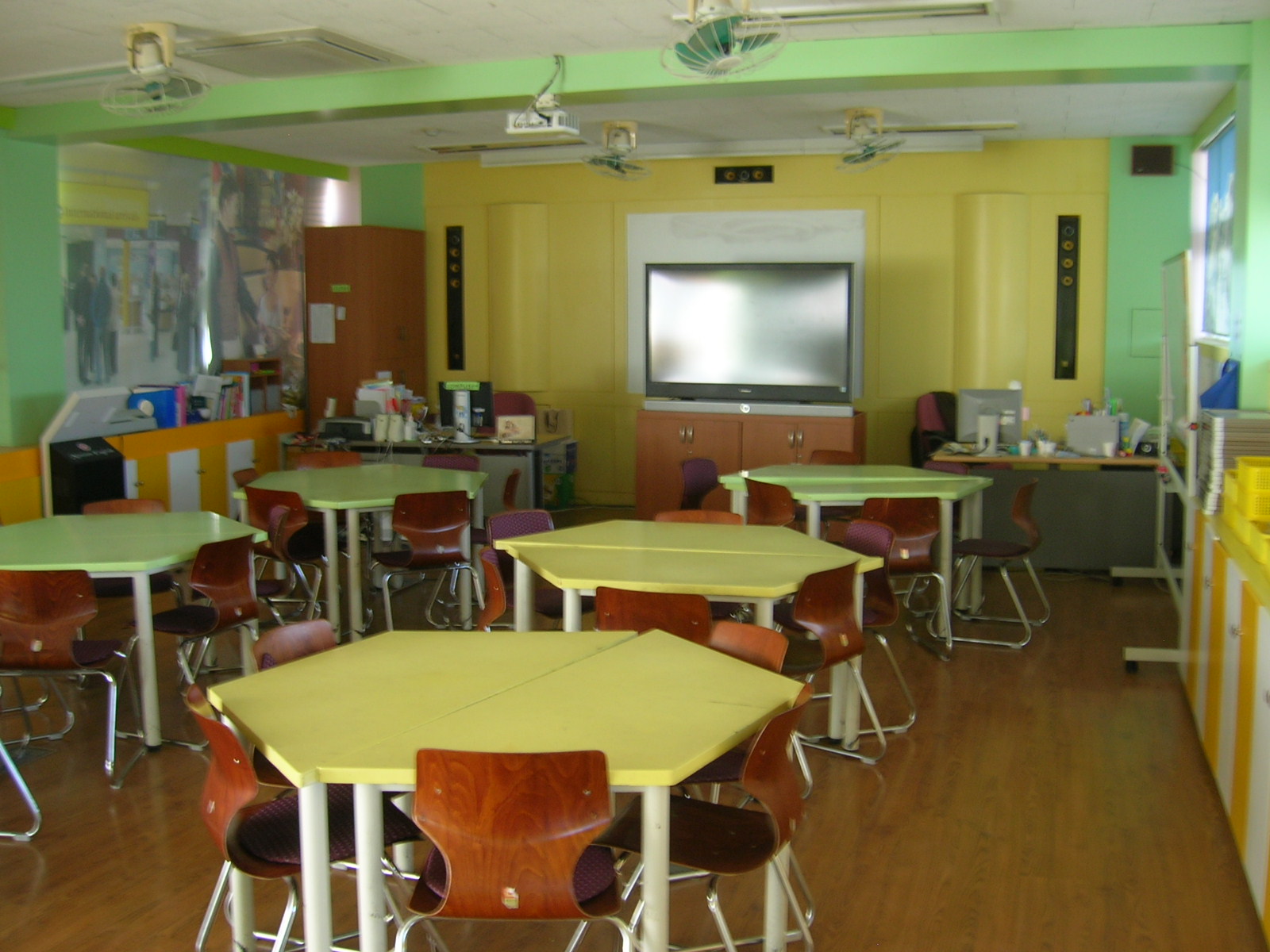 Since I’m posting everyday pictures here it only makes sense to put up one of my classroom. There you go.
Working like this is the only way that makes sense, even if it is tricking myself.
So I’ve got this thing I’m working on. It’s a novel, Science Fantasy, you know, with castles, vat-grown flesh, and pistols in it. Its working title is Clusterfuck, a Novel. It rose out of two distinct stacks of story corpses. The characters in both stacks resemble each other and some of the thematic stuff is similar enough that I’m mashing them together to see if they form a new entity with an actual plot.
Simultaneously I can’t forget they’re also a pile of story corpses: jagged beginnings, characters without plots, situations without resolutions, junk like that, and I’m scavenging and cannibalizing so I can make a Frankenstein Monster Draft I can then rewrite and cannibalize again to find the more supple and sleek monster within.
Writing those first thousand words, even on Draft 0, terrifies me, but taking half a dozen collapsed stories and pasting them into one document gets me so deep into the maze that I feel like I’ve rocketed past the gate and left the fear of starting behind me.
And that’s a good thing.
Quotidian Pohang
 Blue skies from school’s back window.
A Brief History of Tea
Buddhist monks invented tea thousands of years ago in what is today southwestern China. These monks lived atop the mountains and found the beverage improved their ability to meditate over long periods of time. Also it complimented their other super-powers. Soon the habit spread throughout the lowlands, and in the 7th century Lu Yu wrote his now famous panergeric to the beverage, A Fistful of a Cup of Tea. People became ecstatic — so much so that when Lu Yu died he became God.
Centuries passed.
The first westerner to have drunk tea was the north African traveler Ibn Battuta who traveled to India in search of a job. He was impressed by how the beverage invigorated the spirit and increased energy.
After watching one too many of his coworkers get torn apart by angry elephants, Battuta decided to return home. When he got there no one believed a beverage like tea could possibly exist.
It wasn’t until George Orwell wrote his seminal essay, Tea, after singlehandedly defeating the forces of Spanish Fascism, that the English stopped drinking boiled mud and adopted the habit.
The rest is more or less history.
 Yesterweird