10 Favorite Reads of 2013
Here are my ten favorite reads for the past year.
Yes, this list ignores publication dates, and the numbers are arbitrary.
1. A Pretty Mouth by Molly Tanzer
2. Memory by Linda Nagata
3. Snitch World by Jim Nisbet
4. A Stranger in Olondria by Sofia Samatar
5. Dagon by Fred Chappell
6. Temporary Agency by Rachel Pollack
7. Engine Summer by John Crowley
8. Fair Play by Tove Jansson
9. Linger Awhile by Russell Hoban
10. The Trouble With Testosterone by Robert M. Sapolsky
They Never Learn!
 Pick it up and let’s go!
Now With Extra EPIC Flavor
Over at Beneath Ceaseless Skies autarch-in-chief Scott A. Andrews compiled a list of EPIC stories in response to a twitter comment about something or other. My story “Of Shifting Skin and Certainty” got a nod for its use of drugs EPICNESS, which is kind of nice because that story is nearly five years old now and like most (of my) short fiction gets published to silence before being wheeled out to a walled-in garden where it can expire without upsetting anyone.
Anyway, if you like drugs EPICNESS maybe you’d like to check it out. There’s even an audio podcast of it for you deviants into that sort of thing.
And if you’re not into any of that kind of thing maybe you’d like this article on advanced mathematics with Legos in a washing machine.
Law & Order: Elementary School
Strange things are going on in the 6th grade.
For the past two days now, the half dozen lousy* students, an assortment of mean girls, bully boys, and their sycophants, are getting pulled out of classes and taken off to separate rooms where they’re being “interrogated” by the teacher in charge of our school’s anti-bullying program**. Granted it’s the end of the year and it would have been great if these interventions had occurred earlier, but in this world I’ll take what I can get.
* Lousy in the horrible person way, not the poorly performing student way. If you’re a crappy student, but a decent person, you’re okay in my class.
** There’s been a push to get anti-bullying programs in schools here, so that’s great – but in a lot of ways it’s completely at odds with the overall culture outside school (though is this much different than back in the States?), and it’s kind of toothless, which might also be the same as in the States.
Books November 2013
A slow month for reading since I’ve gotten involved with Virginia Woolf’s Orlando. Here are the books I managed to finish:
1. At Amberleaf Fair – Phyllis Ann Karr
A mid-80s fantasy novel set at a seasonal fair and featuring miss-matched lovers, petty theft, and magic. It’s a bit of a curiosity: a secondary world fantasy crime novel where much of the world building and conflict deals with a barter economy and the small ways magic is integrated into everyday existence. At times the styles of the crime genre and the fantasy genre clash, and too often the novel sits heavily on the fantasy side and suffers for it. Still, I enjoyed it because it’s a small scale secondary world fantasy and I’m a sucker for those.
2. A House in Naples – Peter Rabe
A 50s pulp crime novel about two American criminals in post-War Naples. It’s a quick read, full of unlikable characters, and very ugly, but it’s better than most. If you have any desire to read pulp crime, Peter Rabe should be on your list of authors to check out.
3. The Digger’s Game – George V. Higgins
Crime circa-1970s Boston, I liked it but not as much as Cogan’s Trade or The Friends of Eddie Coyle. Still, when it’s good, it’s good and sections of the novel leap off the page. I should also thank Rick Bowes for making me read Higgins in the first place.
4. How To Make Friends With Demons – Graham Joyce
I could see a person hating this book. It meanders, withholds information, and for much of it you’re wondering when Joyce is going to a) get on with it, b) tell you what it’s all about. But if you accept those things and admire how he’s doing it all, then you’ll find much to enjoy here.
5. Storm of Steel – Ernst Junger
War is good! War is great! War! War! War! Junger was a German storm trooper during World War One. He enjoyed the war on the occasions when it wasn’t making him breakdown into fits of sobbing, and this book is his memoir of his experiences. There’s a part early on where Junger enters a field hospital after a battle and he describes the doctor as having a “cold, antlike efficiency in the middle of the carnage”. The book is full of a lot of that.
Know Your History? Some Guidelines For Reading
Every now and then the debate over reading genre classics pops up and rears its ugly head. On the one hand you have folks who feel we’re losing a literary heritage and forgetting too many old great books as new great books get published. Mike Swanwick had a recent blog post to that effect. The genre was once smaller, you could read everything in it, and stay on top of it. It was easier not only to find the firsts in a genre, but also the outliers. Having a hungry curiosity for this stuff is good.
On the other hand you have the opposite position of just knowing what’s current, which in its extreme form might resemble this five year old blog post from Karen Traviss about not needing to read to be a writer. (I don’t know if Traviss still agrees with that blog post, but I’ll keep it until I learn otherwise because it’s useful.) In its milder form, it’s not needing to read every alien invasion story ever, but just those in recent years in order to see how alien invasion stories are being told now in this era.
There’s also a third hand, which shows up in the comments of Swanwick’s post, stating that the “classics” might not be so classic and why navigate through books dripping with the prejudices of their eras. This too is a valuable point, but my reading of Swanwick’s post is one not so much telling writers to know their history and cling to it, but to sift that history and find the gems in it, the outliers as he dubs them, or the books lost in genre’s shadow like the ones I mention here and here.
However there are ways to reconcile these three arguments when you keep these guidelines in mind:
1. Read only what you enjoy, but cultivate a curious and complex palette that enjoys challenges.
2. Make your own genre history. Lots of stuff gets lost in the margins or ignored because it doesn’t tidily fit in with someone’s imposed narrative. Bring these works to light.
3. The early work in a genre has more immediacy than subsequent iterations. It can sometimes be as fresh as more recent works.
4. As far as knowing your genre goes, once you’ve read the initial spark, focus on what’s been done with it in the past decade. But…
5. Always remember there are likely more amazing books that you haven’t heard of than ones you have.
And here’s another post where I carry on in more or less the same way.
Above the Confluence
 The walkway above the newly built canal near my school.
From Swedish Royalty to Pulp Trash
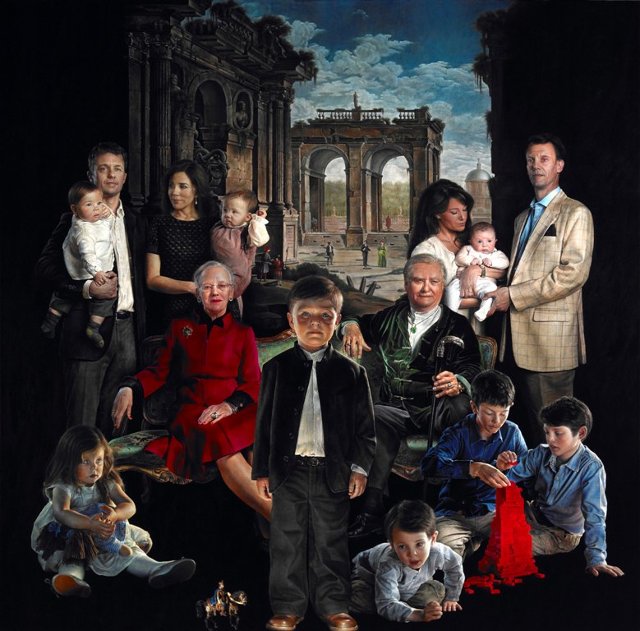 So maybe you’ve already heard about that creeptacular painting of the Danish Royal family. The one by Thomas Kluge pictured above. If not you can read about it here. Isn’t it something? It’s like every VC Andrews book cover I remember from when I was a kid.
When I posted this to Facebook and made the Andrews comparison I asked what was the appeal of her books, and what people told me was that she was basically “like Lovecraft for girls”. Here’s a blog post by the writer Silvia Moreno-Garcia on the subject. Which makes sense, as did my wife’s comment that when you’re 12, you seek out the trashiest stuff you can just because reading those books is like a badge of honor. Other folks talked about how those books addressed the fascination/revulsion teens had about sex or offered some catharsis for teens whose home lives were fucked up, but not that fucked up. So maybe there is a value to trash, especially when painted up as Gothic literature. Or maybe the shit was just fun to read. I never read them, as my trash interests were elsewhere.
But as far as royal portraits go, I think Kluge should do more of them.
I Don’t Remember Playing This Game As A Kid
 It’s always wise to check the class material you find online.
One Book, A Bunch of Covers: The Strugatsky Brothers’ Roadside Picnic
The Strugatsky Brothers’ novel Roadside Picnic is one of those books I read when I can’t find anything else to read. I can pick it up, read a bit, at least any of the Red Schuhart sections, then put it down for months on end. I was doing this last week while waiting for some other books to arrive.
For folks who haven’t read it, Roadside Picnic is an SF novel that takes place in a city after an alien visitation. These aliens are gone, but they or their technologically advanced artifacts have altered a section of the city. This area’s now called the Zone, and it’s heavily guarded and contained, but deserted. The area around the Zone is thick with operatives from various multinational companies and world governments. A thriving black market in alien artifacts exists fed by adventurers, such as Red Schuhart and others, who risk their lives exploring the Zone.
It was the basis of a Tarkovsky flick and a video game and you can make world parallels to Chernobyl, the Korean DMZ, and the Varosha area in Famagusta.
Anyway on to the covers–we’ll start with the non-anglophone ones since the book was first published in Russia. I don’t know if these copies are Russian or Polish. I snagged them from Goodreads.
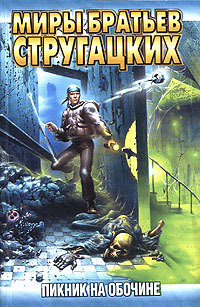
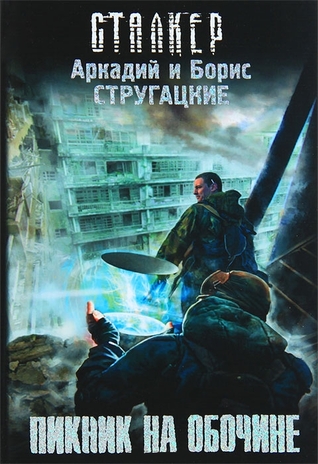
They look like your standard post-apocalyptic SF, and the one on the bottom seems to advertise it’s link to the video game/movie (both are called Stalker), while the top cover makes me a bit nostalgic for the crappy bookcovers of 1980s SF. But only a bit.
Now for four anglophone covers, which are kind of interesting because they show the way the book’s packaged differently for different audiences.


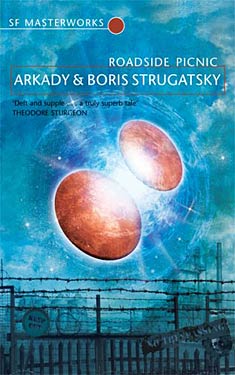

Three of these say SF novel. The top left screams it in all its ugliness. Stalkers are badass lowlives risking life and limb to sneak into a ruined factory in search of treasure. You can’t really be a badass while wearing a silver egghead suit. Top right is the version I own and has a decent understated 70s SF bleakness about it. Bottom left I like-but what it shows, a “full” empty, is boring, especially when you’re book’s about low-life, bad-asses yaddayaddayaddaing.
The fourth cover, bottom right, this one is the least SFnal of them all. Sure, Ursula LeGuin’s name is on the cover, and there’s mention of the movie and video game. But the image comes from the Tarkovsky movie, and there’s that “a new translation”, which I can’t help but read in a hushed, reverent tone. All that makes me think it’s being sold to readers of translated international fiction and Tarkovsky fans over SF fans. I’ve no problem with that, but it’s interesting to see how the book’s pitched for another audience.
Anyway, what do you all think?
 Yesterweird