RED SPECTRES 02: RED PRIMROSE

Welcome back!
In this entry we’re looking at Aleksandr Chayanov’s story “The Tale of the Hairdresser’s Mannequin”. It’s an odd one.
“The Tale of the Hairdresser’s Mannequin” by Aleksandr Chayanov (1918)
We start in Moscow. Our protagonist is a popular architect noted for his romantic conquests. The scene’s less Russian and more French as our protagonist is both a dandy and flaneur. One night’s he’s out and about doing his best to defeat his ennui, when he gives up and decides to take a vacation in the provinces. Soon he’s infatuated with the red-headed wife of a local veterinarian and is all set to begin a new romance, when he comes upon a beautiful red-headed mannequin in a hairdresser’s shop window. He quickly purchases it and so begins his new obsession. Where did it come from? Who sculpted it? More importantly, who was the model? Etc. Etc.
And so a tangled tale is spun. The models were Siamese twins and the mannequin is but one of a set of two. The artist who sculpted them went mad and killed himself. No. No one knows where the twins are now. Mystery piles upon mystery. The architect is now in deep. By now he’s purchased both mannequins and is traveling with them all around Europe. Where are the twins? He becomes an expert in the side show-carnival-panopticon circuit. A chance encounter with another carnival aficionado provides him with the twins’ name, the Henrickson sisters. But there the trail goes cold. The twins have retired into seclusion for some reason. All hope is lost for our architect until he spies a billboard in Venice announcing the return of the Henrickson Sisters.
From there the downward spiral really kicks in. Yes, he goes to the show. Yes, he goes backstage. Yes, he succeeds in wooing one of the sisters (Berthe). And yes, she gets pregnant. All this we learn from the diary of the other sister (Kitty). Kitty also explains about the sculptor’s tragic death (he didn’t know it but he was the twins’ half-brother a fact he found out only after he too slept with Berthe). Of course, Berthe gets pregnant, and also of course she dies during childbirth. This allows Kitty to be separated from her sister, and she takes off with her newly-born niece while our protagonist abandons everyone (including the mannequins he’s been carrying around) and returns to Moscow.
Back home once more, the ennui returns. This time instead of the provinces he decides to go back to Venice. And he books the same room he stayed at before when he first saw the poster advertising the Henrickson sisters. Unfortunately all he can see are the mannequins he abandoned. They have been reunited in another hairdresser’s shop window. The sight of which promptly causes him to have a nervous breakdown. The end. Except there’s a bit of an epilogue as a fat rat back in his abandoned Moscow apartment gnaws the ribbon off a stack of love letters hidden in his desk.
THE END.
As I said this story is an odd one, and if you told me Chayanov meant it as a parody of the Gothic style I’d absolutely believe you. The fat rat at the end inclines me to this idea. It’s there gnawing away at the ribbon that ties it all together. When the rat succeeds, it only unleashes an avalanche of old love letters.
Good stuff.
Midway through I was struck by how science fictional this whole story was in an Albert Robida kind of way. I could imagine clones and robots alongside the stereo-cinematographs. Oddly the Europe depicted doesn’t appear to have just fought a terrible war. And the Russia depicted doesn’t appear to be undergoing a terrible war, so that date of 1918 might be when published instead of when composed. This story also made me look back at the Oskar Kokoschka/Alma Mahler affair. You’d think if two cultural icons had an affair that ended with one making a life-sized anatomically correct plush doll of the other it would earn a mention on one of theirs wikipedia pages. But no. Fortunately, the Paris Review has us covered. (Content warning for pictures and description of life-sized anatomically correct plush dolls and the men who buy and decapitate them.)
Next time… A mirror? A mannequin? Another excuse for me to share unsettling facts from the past? Who knows?
RED SPECTRES 01: BEYOND THE CHEVAL-GLASS
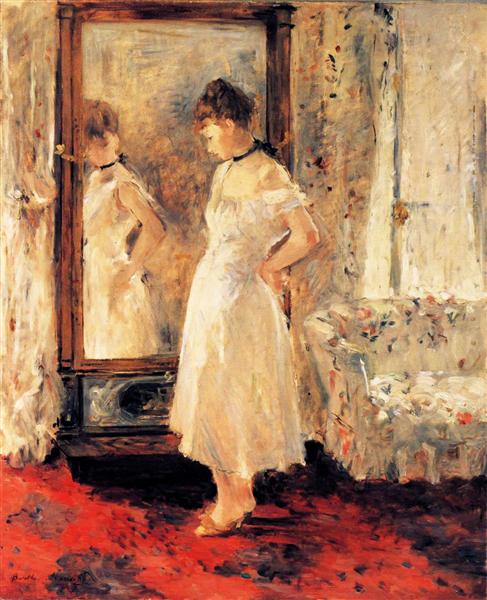
.. and welcome back to Yesterweird.
I did a brief post over on patreon looking at the introduction. Red Spectres is going to be a very different read than our last one. For one, it’s not in the pulp tradition. For two, I can’t think of any Weird Tales writer who ever got “disappeared” by government agents. As a patron said, Soviet Lit is “too real”. But don’t be scared. Our first story, “In the Mirror” by Valery Bryusov, isn’t quite as real as all that. With it we’re still firmly in the late 19th century weird story tradition.
Bryosuv’s one of the big figures in Russian Symbolist literature in the first decade of the 20th century. The only other thing I’ve read by him is The Fiery Angel – which I absolutely recommend if you like weird 19th century novels. (You can read my reaction to it here.) It might not be as over-the-top as The Monk, but it’s still pretty juicy. “In the Mirror” is enjoyable too and works well as our first step into the anthology.
“In the Mirror” by Valery Bryusov (1903)
A young woman with a fascination for mirrors gets drawn into a confrontation with her own reflection after she buys a cheval-glass. Is the reflection a ghost? An other worldly being? A sign of the narrator’s disordered mind? The story does have “From the archive of a psychiatrist” as its subheading. If you stuck to the surface details you could certainly find an allegory against vanity here. But that doesn’t feel nearly as interesting as the ideas of identity boiling away under the story’s surface.
“There were mirror worlds that I loved; and there were some that I hated. I loved to project myself into some for hours on end, losing myself in their enticing spaces. Others I avoided. Secretly, I did not love all my doubles. I knew that all of them were hostile towards me, if only because they were forced to don my hated appearance.”
Our narrator isn’t vain or simply self-absorbed, but she’s fascinated by the possibilities mirrors offer her. She not only loses herself in these reflected worlds, but she becomes other selves. The mirror is a psychological comfort and escape. But when she buys a new cheval-glass and looks into it, the reflection there frightens her with its visibly cruel gaze and haughtiness. Soon the contest of wills begins, and very quickly the woman realizes her reflection is the stronger of the two. She fears what she sees, but remains compelled to look anyways. Then one day, her reflection commands her to approach the mirror. The woman does and when she reaches forward to touch the glass, her reflection takes hold and swaps places with her.
From there our narration starts to outline the world beyond the cheval-glass. It’s good and creepy: a numb fluid world of slumbering souls, longing for some stable reality where they no longer serve as puppets for those who live beyond the glass. And the more the free reflection stands before the mirror insulting the trapped woman, the more conscious of her predicament the trapped woman becomes. Before too long each duel returns her more to her self and a stronger desire to break free. The reflection senses this and orders to mirror boxed up and sent away. The woman, realizing it’s now or never, commands her reflection to stand before the mirror one last time. The reflection orders the workers away, and then the final duel begins. The woman emerges from the glass and throws the reflection back in its place. Free and overwrought by her experiences, the woman promptly has a nervous breakdown and collapses on her bedroom floor.
But there are a couple paragraphs more, as the woman tells us how certain she is that she is really herself and not her reflection. She is sure. Really, she is. But she wants to be absolutely sure – so she wants to look in the cheval-glass once more. One last time, to be absolutely, one hundred percent, completely, pneumatically sure. Let her look in the glass one last time and after that she’ll be cured.
Like I said it’s a good story. It delivers the weird without feeling like an over-wrought ad for a particularly salacious brand of soap. No offense to Everill Worrell and Greye La Spina, but the pulps aren’t far from that.
Next story brings us mannequins.
Until then!
(Artwork by Berthe Morisot)
THE LOCAL CAMPAIGN // MYSTHEAD

Recently my game group wound down our D&D campaign for a bit of a breather. I’m the GM and we’re using Beyond the Wall as our rules. I’ve run Beyond the Wall before (here’s the first post about that game), but this time I leaned into its implied YA fantasy setting. The game had a teen delinquents and their up-tight friend solve/commit crimes and fight monsters feel to it.
Some notes and revelations:
- Magic. BtW keeps it scary and unpredictable, so much so a few times the party had beneficial items that they were too frightened to use. Also every mage the players encountered was awful or at the very least damaged in some way. A downside to this is that the spells veer towards the looser end and require negotiation between player and GM.
- Small setting. The furthest the players traveled from the village was four days away. Most of the time they were interacting with known people and places around town. Known dungeon sites got a bit of that Zone spice, never quite cleared out, but always there spooky and weird just beyond the edge of town. It also opens the calendar and locations.
- The Calendar. Some places are more powerful at certain times than others. Some locations only appear on nights of the full moon. The cult is having their meeting a week from now. If you hurry maybe you can get there. I wasn’t that strict with it, but I certainly made it a bigger part of the game than I’ve ever done in the past. One danger is it can become grindy as players try to divide turns down into rounds like they’re riding Zeno’s Arrow.
- Locations. Make places magic items. Light a fire in the old temple and no fire can harm you while you remain there. Stop by the local saint’s shrine before setting out and get a bonus. This is one way to keep magic limited and add a strategy element. This location has this effect. This other location has a different effect.
- Pesky Kids. I dug the teen detectives uncover secrets and solve crimes angle and played up the fact that except with few exceptions no adult was going to take the teens’ accusations seriously. I did this until one player asked me to stop because they found it triggering. By then they hated the home village (with its stupid adults) so much they had to be coaxed into protecting it.
- Reputation. Small town reputations provide a lot of pressure points for characters. At one point the delinquents got kicked out of their house by their guardians (the twins did burn a building down). They ended up having to pay rent at the inn. And they hated it! But I loved saying, “Master Barrelhelm wants his gold piece for the week.”
- Who Gave the Kid a Knife? Despite the characters being 18-year olds, the players weren’t and for some reason those with kids of their own were reluctant for their characters to give an NPC teen friend a bunch of weapons. Go figure.
- No Hirelings. It’s hard to hire a bunch of torch-bearers and Men-At-Arms to use as meat shields when you’ll have to see their widows and orphaned kids around town. Despite this the players had a couple of NPCs they could occasionally lean on.
If you want to read more about the game, here’s a link about its inspirations.
MYSTHEAD APPENDIX N / BEYOND THE WALL

This is for those random persons who enjoy reading about other people’s TTRPG games. Here’s a look at all the material that went into the recent game my group and I finished*. Expect a lot of links to wikipedia pages.
THE RULES USED
Beyond the Wall
We use all the Beyond the Wall material to date. Its roots are as a retroclone of D&D, but it welds on bits from AD&D (race and class) while keeping the rules loose enough. I’d love to see it overlap more with more narrative games like Dungeon World and Five Torches Deep. Also since BtW leans into YA Fantasy for its inspiration I could easily see another table mixing it up with Monster Hearts. For what it’s worth, BtW’s version of the Banshee has one of the best save or die mechanics.
The one bad thing about the rule set is that it’s scattered across multiple books. Personally, I’d love to see an omnibus “Rules Cyclopedia” edition published some day. Through Sunken Lands (the latest iteration of the rules) does this somewhat, but TSL has a different vibe. TSL is bronze age sword & sorcery, and not the high medieval YA fantasy we wanted.
OTHER GAMES & SUPPLEMENTS
- Dolmenwood: For the vibe more than the particulars, although I did lift the Haunted Abbey from here and tweak it.
- Harn: I’m a fan but have little time for its level of detail. Doesn’t stop me from pillaging it for names and lore, especially its pantheon.
- B10 Night’s Dark Terror: One of the greatest D&D modules. A good story and mix of wilderness and dungeon adventures.
- The Gazetteer Series of D&D products. Again, it’s less the details and more the names and site tags.
- Carse and Midkemmia Press’s Cities supplement
MOVIES
Some provided plots, others only atmosphere.
- Night of the Demon: The cursed parchment, the hypnotism scene, the congenial devil worshiper, and the arrival of some inescapable doom at a certain time.
- The Old Dark House: Nobody scares like Brother Saul!
- Texas Chainsaw Massacre: Every fantasy game needs a backwoods clan of cannibals. My players rightfully called me out when I gave them southern accents.
- Phantasm: It, like my game, is stitched together from whatever seemed weird/cool at the moment.
- Harold & Maude: Maude’s the model for the elderly shield maiden having a fling with the party’s wizard.
- The Mummy // Crouching Tiger, Hidden Dragon: Do you need links to these? Both do a great job blending fantasy and naturalism. Okay, The Mummy doesn’t but the action’s fun and the props are bulky. It leans gracefully into the yakety sax.
- Rankin & Bass’s Tolkien and The Last Unicorn movies for their cute but grotty weirdness and because they’re deeply imprinted in my brain.
- Those Passolini Trilogy of Life movies set during the Middle Ages/Renaissance did similar imprinting from a different direction.
- Spaghetti Western // Hammer Horror // Shaw Brothers movies all mashed together and left to ferment and link mycelia. In my opinion these three genres meld very well together.
BOOKS // AUTHORS
- The Hardy Boys and Nancy Drew books by way of spoof covers.
- Fritz Leiber’s Lankhmar stories
- The Innkeeper’s Song by Peter Beagle
- The Book of Goblins by Alan Garner (Yallery Brown!)
- One Thousand and One Nights (Especially that story where Sinbad gives a piggy-back ride to an awful man.)
- The Long Ships by Frans G. Bengtsson
- Goblin Market by Christina Rossetti
- The Wizard of Earthsea series by Ursula K. LeGuin
- Chaucer’s Knight by Terry Jones
- Be Like the Fox: Machiavelli in His World by Erica Benner
OTHER STUFF
- Early American Serial Killers and Mississippi River bandits like the Harpe Brothers.
- Every European folklore page on Wikipedia. I would try Stargazey pie.
- Cherry picked bits of Medieval/Early Renaissance History.
- Cape Ann.
*It’s not done, but we reached a good pause point and I wanted to take a break and other people wanted to run games. The goal’s to come back to it before the end of the year.
WOMEN OF WEIRD TALES 13: THE ANTIMACASSAR

Macassar oil. Do you know what that is?
Macassar oil was a hair product that became popular during the 19th century. It was made from coconut and palm oils. Everyone back then wore so much of it that the fabric headrests of chairs would get a worn polish on them. This was unseemly in the eyes of society. Enter the antimacassar: a thin, decorated bit of cloth you could slip over a chair’s headrest to protect the fabric. If you’ve ever ridden on a bus or train, you’ve likely encountered an antimacassar. I knew none of this before reading this week’s story. Now I do and so do you.
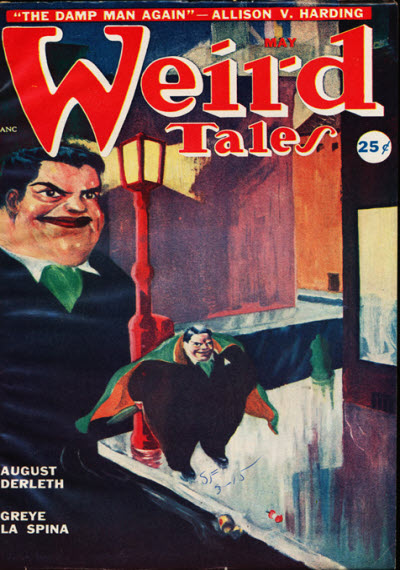
“The Antimacassar” by Greye La Spina (May 1949)
This is a decent story and one that makes for a good ending to the collection.
Our heroine, Lucy Butterfield, works for a textile company. She’s on the road showing samples, but really she’s trying to find her missing friend, Cora Kent. Cora was the sales representative before her and went missing somewhere in the back country. Our heroine has tracked her to a remote farm where a Mrs. Renner and her handy man live, along with the sickly Kathy Renner who is twelve years old and confined to bed.
Mrs. Renner claims not to have seen Cora, but Lucy suspects they know something. It was there that Cora made the strange antimacassar with its pattern of circles and snakes that puzzled Lucy so much to send her out here. She lingers around the farm maintaining the pretense that she’s simply the road rep for a fabric company. Soon Kathy’s whining that she’s hungry and there are strange sounds at Lucy’s door. Then the nightmares begin of a monstrous child that feeds on her.
Lucy finds herself growing weaker, and slowly she realizes she must leave, but Mrs. Renner keeps sabotaging her attempts. In between all this Lucy and Mrs. Renner discuss needlepoint and fabric. Finally, the monstrous child appears. What a shock! Kathy is a vampire! But fortunately, the heroine’s strapping lad of a boyfriend, Stan, shows up right there and kills the monster child. Lucy sent Cora’s strange antimacassar to his mom and right away he realized the snakes and circles were an SOS message. What’s odd is no one is shocked by the vampirism. Apparently, everyone in this world must be a Weird Tales fan and expect such things. The End.
I dug this story. It had a nice mix of the morbid and the mundane. And enough of my family worked in New England’s textile industry, so it was neat to see something similar here. (It actually takes place in backwoods PA, but I imagine the two are similar.) And while the heroine is ultimately saved by a strapping lad, she is the one throwing herself into harms away to rescue a friend and do the detective work. I might have wanted the collection to end with more Everil Worrell, but this was not a bad place to finish. From here it’s easy to see Shirly Jackson and Stephen King on the horizon.
And that’s it.
We have reached the end of The Women of Weird Tales. I hope you all have enjoyed it. The collection is great fun and I recommend it. Maybe if enough people buy it Valancourt will put out a fancy Everil Worrell collection!
I’ll post my top 5 favorite stories over on my patreon. If you’ve enjoyed this series, why not consider becoming a patron. Or not. You do you. You can expect the Red Specters reviews to start sometime in June.
Stay well!
THE WOMEN OF WEIRD TALES 12: IT’S YOUR BOI AGAIN… THE GREAT GOD PAN!
This is it.
The penultimate story. And it’s a story that asks an important question: What if Weird Tale writers didn’t have so many sex hang-ups?
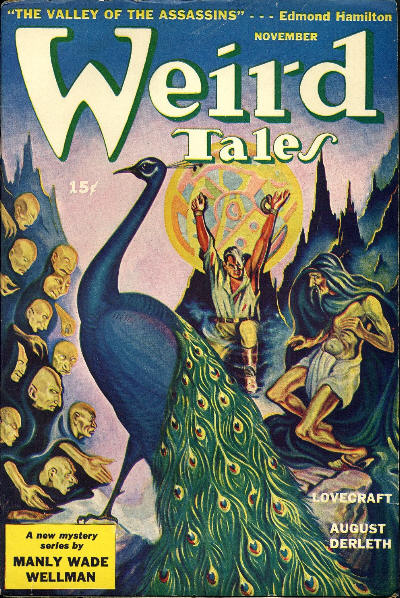
“Great Pan is Here” by Greye La Spina (November 1943)
Our narrator’s driving along after having five cocktails with his cousin Cecily and their chaperone, Aunt Kate. They are on their way to the symphony. Now Craig, our narrator, has the hots for cousin Cecily and fears that her upbringing under the old-fashioned Aunt Kate is making her too reserved. He wishes something would wake the girl up to the world of love and emotions. Especially his emotions for her. Then side the road he glimpses a pan pipe. It’s just lying.
Was it real? Was it not?
He hesitates to bring it up. Aunt Kate hates missing the opening movements of a symphony. But he does, and no one believes him.
Later back at home our narrator drinks some more and appraises the effects of moonlight on his garden. He’s got a new nymph statue he brought back from Italy, and it’s pretty sweet. Musing such, he’s surprised when he glimpses someone in his garden. He goes to investigate and finds no one but hears the faint piping of a pan flute.
Was someone taunting him?
But no matter how desperately he searches he can’t find anyone, so eventually he goes back to the house.
The next morning Cecily’s dressed for yachting and our narrator’s thinking thoughts of love and goddesses and basically being a lusty horndog except in an Edith Wharton sort of way. He’s about annoyed when she suggests inviting along a friend, Tom Leatherman, they bump into. They all pile into the boat and our narrator fumes as he gets the yacht going. Meanwhile Tom’s talking about the pan pipes he found on the road the day before. Cecily hears that and apologizes to our narrator for not believing him the day before. Craig accuses Tom of sneaking into the garden and playing the pipes. But Tom denies it was him. Then Cecily startles everyone by saying she heard the piping too, and if it wasn’t Tom who was it then?
If only they had read the title of the story they are in.
There’s more sailing. More brooding over pan pipes. More talk of strange notes being played in the air. They go back to shore and ditch Tom Leatherman. Then Craig and Cecily go in the garden for a picnic. They’re starting to warm to each other. The mystery of the pan pipes has made a bond between them. But as they walk they find they’re not alone in the garden. A strange man is there.
Strange and foreign looking.
It’s the Great God Pan.
He then gives them the pitch. He’s an old god making his way in the new world and he’s looking for gardens that bear something of the old ways about them. Craig’s garden with the imported nymph statue is one such place. And Pan wants it. In exchange he offers to give Craig what he desires (Cecily).
This is where something interesting happens. First there’s talk of haggling and buying affection with gold, but Craig says that’s not how it’s done these days. Now it’s love that seals the deal and love that is exchanged freely between individuals. Cecily needs to give her consent in order for there to be a deal. And she does much to Craig’s delight.
Pan’s pleased and says he’ll be back later that night.
Now Craig and Cecily start to wonder what exactly they’ve done. They’ve invited an old god into the garden. That’s not something you can just admit to the yacht club. However they do decide to get married and when back inside they tell Aunt Kate and she’s happy, but still doesn’t want them to be alone together.
Night arrives. Time for bed. Once the house is asleep Cecily and Craig sneak out into the garden. The music starts. The Great God Pan is there.
Ecstasy, dance, sex, etc.
And it was all okay.
I’m not quite certain at the level of consanguineous between Craig and Cecily. I’m thinking they’re like third cousins, which strikes me as weird but not awful. There’s a bit more the next morning where Aunt Kate mentions the nymph statue seems to have lost her scarf, but that’s pretty much the end. But overall, nothing awful happens.
At least nothing awful relative to your views of conjugal relations between distantly consanguine relatives and Paganism taking root in the USA. If you’re cool with all that this story is simply The White Goddess meets Edith Wharton. Premarital sexy times are had and no one is hurt who isn’t already more than a little bit dead inside, and they’re only hurt by having a bad night’s sleep.
La Spina likes her purple prose and manages to dress all her words in such a way that they wear diaphanous gowns. Sure, it reads a bit stilted and melodramatic, but it’s not without its charms. And the sex positivism and enthusiastic consent ideas are refreshing. Like why would I be outraged that two young adults who are obviously into each other sleep together? Is it because they do it under the influence of strange rites conducted by a swarthy foreign man? That’s silly.
Of course, it’s possible that I missed some sinister element in the story. But I don’t think so.
Next week, our last story from The Women of Weird Tales. It’s another from Greye La Spina, and it’s called “The Antimacassar”.
Until then stay well.
WOMEN OF WEIRD TALES 11: ENTER… THE EXPOSITION!
This is one of those stories where someone in a barroom meets a long lost someone else and listens as the lost someone tells how they got so lost, and in between the telling the first someone, the narrating someone, has a multi-page flashback detailing their relationship to the lost someone, because who the heck ever pays attention to anyone when they’re telling their life story?
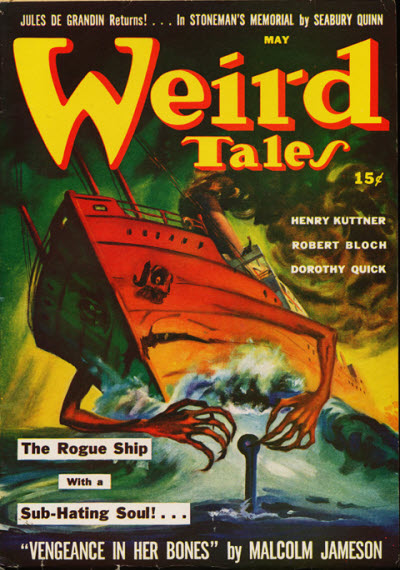
“The Deadly Theory” by Greye La Spina (May 1942)
Our narrator is in a bar. They’ve bumped into an old acquaintance named Julian Crosse. Julian joined the French Foreign Legion and disappeared in 1914. He’d long been presumed dead. But maybe not, because there he was with his piercing blue eyes, smoking, and sipping gin and tonic. So as the narrator smokes and drinks they listen to this man who may or may not be Julian Crosse tell his story. Except first comes the exposition.
Julian was a painter of the Corot sort. Paintings of ladies. Paintings of ladies in nature. Except it’s only one lady. A beautiful lady. Beautiful paintings too. For a time. Then a change happens. Lady becomes hidden. Beauty’s gone. Something “unhealthy” has seeped into the pictures. Reporters want to know what happened. They track Crosse down and hear a story about sisters. One died. One lost her mind. Julian loved that one. Painted her before her accident and after. Hence the “unhealthiness”. Julian didn’t affirm or deny this story. He said it’s best not to talk about such important things. Then he split for France and the Foreign Legion. First though he said good bye to the Narrator. Goodbye. He said. I loved a woman and she died. Now I’d rather be dead. So I go die now in France like a bridegroom on his wedding day. Backstory done, time now to listen to what this guy who might be Julian Crosse is talking about.
And so…
Julian met a girl. Her name was Marzha. Her sister was Idell. Their father was a sea captain. Their mother a “passionate” Persian. They died and the girls were left with their Uncle, the Occultist. He home schooled them. There’s no mention of how Julian met Marzha, but he does. And she’s totally great and perfect. She brings Julian home to meet her Uncle, the Occultist. He looks like Moses and always has some occult experiment going on. He likes Julian. Hurray. Hurrah. But Idell the younger sister was not happy at all. She was more highly sexed then her sister and she wanted Julian. But he was like no thank you. So he leaves with the Uncle the Occultist to buy “herbs” in the city. When they come back Idell greets them in hysterics. Turns out Marzha ate some poisoned mushrooms. Turns out Marzha is dead. But wait, Uncle Occultists says, Marzha knew mushrooms too well. She’d never eat a poisonous one. What if Idell did it on purpose! Shock. Surprise. The girl flees. Uncle Occultist gets an idea.
Palingenesis.
That’s the pseudo-science name for the reproductive method of phoenixes. Burn yourself up, get born again. Easy peasy, lemon squeezey. Be reborn. Life after death.
They built a fire and burned Marzha’s body. An urn was found for the ashes. All of the ashes down to the finest particle. Then there’s more occult shenanigans. Blood. Magic circles. Incantations. The whole shebang. After some time Idell has to get roped into the ritual, because it’s a three person thing. From the urn rises a phantom of ash. Marzha!
Except the body is as it was upon the moment of death, gas-inflated and bloated from the poison’s rapid action. Oops, Uncle Occultist says.
In the aftermath, Julian’s freaked out. Idell’s freaked out. Uncle Occultist is pleased because it’s cool to bring people back from the dead. Marzha’s body is a soulless zombie that needs to be misted with magic blood fluid from a spray bottle like she’s a house plant. The more blood mist she gets the more alive Marzha becomes. Except Idell kills herself unbeknownst to all, swapping in her own blood. Whoopsie, it’s her soul now in Marzha and she still has the hots for Julian! He bales. He bales faster than Christian Bale baling at Bale-Fest. Marzha-Idell is like what! how dare you. Julian smashes the spray bottle. Haha. No more blood. Marzha-Idell dies. Uncle Occultist is sad. Julian skips town and tells the narrator he died in 1915.
But how can that be? Julian is here drinking with the narrator. Suddenly an Old Man appears. It’s Uncle Occultist. He escorts Julian away. But before leaving Julian says, “Some folks never know when to quit.” The pair exits the bar. The narrator decides to get drunk which is saying something because at this point in the story I think they’d already had four scotch and soda. The end.
Next week?
The Great God Pan makes a mess… again.
WOMEN OF WEIRD TALES 10: YOU SAY UBIK. I SAY UBIQUE.
We have entered the Virgil Finlay era. Look at this cover. Isn’t it great?

Imagine seeing that on a newsstand. I am going to go out on a limb and assume the issue had a reprint of Everil Worrell’s “Vulture Crag” in it. So, technically, this is our second story that received a cover illustration. It’s just not the story we’re here to talk about right now.
“Web of Silence” by Mary Elizabeth Counselman (November 1939)
The scene is Everytown, USA. Sinister things are afoot. Threatening letters have appeared. They are triangular. The script oddly “foreign”. The letter writer, a Dr. Ubique, foretells disaster on a given day at a certain hour. They demand money. At first the town leaders laugh this off as a harmless crank. But then the day and hour arrive and the disaster strikes: Silence. Silence so deep so impenetrable that the whole town comes to a standstill. And that’s the story. What we read is the day by day as people try to go about their lives in the zone of silence. There are tragedies and misunderstandings, comic scenes, and lots of confusion. In a neat touch outsiders start visiting the town as tourists and the highways get gnarled up as people travel into and out of the “sound limit”.
This is one of those odd disaster stories where something bad happens, but it’s not too bad and no one is to blame really. Even when Dr. Ubique reveals himself (a foreign scientist), he admits his letters were all a prank. He’d learned about some rare metals beneath the town and predicted how they would interact with certain approaching environmental conditions (cosmic rays from a nova). He wasn’t the cause, but only the observer. So you can’t blame him. Here’s your money back. Thank you very much and sorry for the trouble.
Overall this story’s fairly ho-hum and never goes full throttle. I mean “The Week It Got Really Quiet” isn’t much of a catastrophe, is it? But what it does depict is some of that 1930s sensawunda. The world is full of scientific marvels and natural laws we barely understand, and they are occurring directly beneath our feet and above our heads. Our Dr. Ubique is both mad scientist and harmless eccentric. In the end nothing will be irreversibly broken and everything will be okay.
Honestly, I felt a bit cheated.
If you’re a Philip K. Dick fan your eyes will likely have lit up at the name of Ubique. Not that there are many connections between this story and Dick’s novel Ubik, but it shows he had no problems reiterating on decades older work. What I am saying is no one should feel ashamed for riffing on old stories. Philip K. Dick did it all the time.
Next week?
A story I have absolutely zero memory of reading. I must have, because I finished the book, but what this particular story was about I have no clue. I guess we’ll find out next week, won’t we?
THE WOMEN OF WEIRD TALES 09: STATUES, BIG AND BLACK
We have entered 1930s era Weird Tales. Gone are the fever dreams of Everil Worrell. The next set of stories have a much different and more recognizable tone. In a less charitable mood I might even describe them as “meh”.
However, the covers, as you can see, remain saucy.
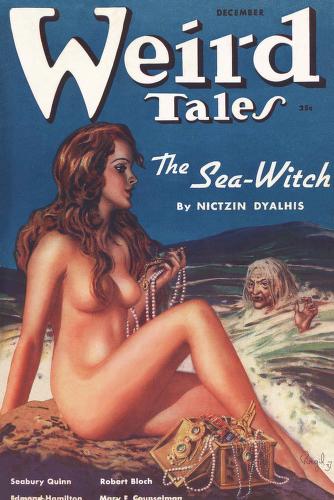
“The Black Stone Statue” by Mary Elizabeth Counselman (December 1937)
Dear sirs,
My name is Very Successful Artist. I am writing this first hand account of how I became so successful. It all started in my rooming house where I encountered my long missing friend, Famous Explorer.
Now, as you can imagine, I was surprised to find Famous Explorer in such a low boarding house with such a meddlesome landlady. She spoke in this dialect of English that uses many apostrophes when I transcribe it. Overall, she was awful and wouldn’t even allow her boarders to keep a radio. I bring this up because there was a high-pitched sound coming from Famous Explorer’s room. Now I managed to corner my friend and through some arm-twisting I got him to relate his story. I will now pause my first-hand account to let Famous Explorer give his first-hand account of what happened.
Hello, my name is Famous Explorer.
I was deep in the jungles of South America. It was exactly like all those pictures of jungles people show in those movie serials. One day, my assistant, Ethnic Stereotype, went missing and I had to go find him. When I did find him it was in this strange part of the jungle where everything had been transformed into vividly detailed black stone. Needless to say he had been transformed as well. Poor, Ethnic Stereotype. Now it turns out in this jungle was this very beautiful snail-slug-orchid-thing and it turned everything it touched into this black stone. It also makes a high-pitched sound. Believe you me, it took all manner of derring-do to not get turned to stone myself, but I managed to capture the thing. Now I’ve brought it back to civilization where I plan on exploiting the thing for industrial purposes.
Oh noes!
Very Successful Artist has pushed me on top of the snail-slug-orchid-thing. I am now dead.
Sadness.
Yes, that is correct sirs, I, Very Successful Artist, turned Famous Explorer into a statue and stole the snail-slug-orchid thing. I did the same to the landlady and a bunch of other people. All my statues have been created using the snail-slug-orchid thing. My whole career is a sham. I am going to throw the snail-slug-orchid thing into the ocean and kill myself now.
Thank you and goodbye.
Sincerely,
Very Successful Artist
###
And there you have it: “The Black Stone Statue”.
It was okay, very much the ur-cliché of a cliché. I feel like this strange creature that transforms/mimics things was a staple in a Philip K. Dick’s work. I don’t know if he took the idea from this Counselman story, but it’s not hard to imagine that he did. Which is fine. He ran with it and made it his own.
Next week?
A web of silence.
THE WOMEN OF WEIRD TALES 08: THE GRAY KILLER
Have you ever spent a night in a hospital?
Confined to your bed with nothing but that empty quiet to listen to and the faint repetitive sound of some life-assisting machine? And there in that quiet somewhere you hear someone walking, their soles scratching slightly across the tiles as they come closer to your door.
That’s not a doctor.
It’s …

“The Gray Killer” by Everil Worrell (November 1929)
Hey! Look at that. The first of the stories from this collection that have gotten a Weird Tales cover illustration. Overall it’s pretty bland and fails to convey the story’s claustrophobic dread. It also posits some sturdy hero leaping in to save the victim when that’s far from the case.
The year is 1928. Our heroine’s name is Marion Wheaton. She’s in the hospital because she stepped on a nail and got blood poisoning. We are reading her diary where she has set down the terrible things that befell her. Worrell conveys the loneliness and confinement of being laid up in a hospital bed really well. We learn a bit about the ward and the other tenants: an injured man, a sick child, a cancer patient, the nurses, and others.
As Marion lies awake one night, she hears a shuffling, slithering step in the hall. She stares in dread at her doorway where she can see into the hallway beyond. Slowly, a figure emerges – a man dressed in gray and whose face in the dark even looks gray. Marion’s afraid of him at first, but he introduces himself as Dr. Zingler and does his best to calm her. He’s rather grim and hungry looking, but Marion makes an effort. When she explains what’s wrong and how her foot pains her the Doctor asks if she’d like an injection. This being an Everil Worrell story Marion hopes the needle contains morphine, but when Zingler produces it the medicine within is a viscid, slimy, yellowish-white foul-smelling gunk. No way is Marion letting Zingler put his filthy medicine inside her veins! She makes a fuss and the Doctor tries to shame her. If she’d rather stay in pain, he says, there’s other patients who would be happy to receive his injection. He goes across the hall to the cancer patient’s room.
Later when Marion talks to the nurses she brings up Dr. Zingler. The nurses however have nothing special to say. They like the Doctor and think he’s all right. A real dreamboat. Marion plays her cards close to her chest and doesn’t voice her own opinions. It’s not until a bit later when Dr. Rountree visits that a shock reignites her curiosity. Rountree says the cancer patient across the hall has miraculously recovered! How can this be? Marion tells Rountree about Zingler’s visit and how that doctor went to give the patient an injection. Rountree’s a little puzzled by this but takes it in stride. Nothing out of the ordinary, except Zingler should get the nurses to do the injections otherwise patients are likely to expect to have their faces washed by the doctors. Marion takes all this in, including the miracle cure, but she’s still glad she didn’t get a dose of Zingler’s medicine.
Night comes. Marion’s foot still troubles her. She can hear the injured man down the hall and why won’t anyone give him something for the pain? Why isn’t anyone helping him? Only then she hears that slithering tread in the hall and realizes Dr. Zingler has arrived to take care of the man. After that there’s silence. In the morning Marion learns the man has been miraculously healed.
What was in that needle Dr. Zingler gave his patients?
Days pass. Marion’s foot is healing. The boy down the hall who had the difficult tonsillectomy has healed rapidly and once more all the nurses are amazed. As Marion hears of each of these recoveries, she grows more and more afraid. The nurses start to wonder about her nerves and think she might be approaching a nervous breakdown. Then the story takes a turn.
That boy? The one who got his tonsils taken out. He’s found dead and dismembered, his body draped over the operating room’s skylight. Worrell dials the lurid up to eleven here and goes into a few paragraphs of bloody, impaled on a hook, murdered child descriptions. It’s pretty grisly.
Marion snaps and starts talking about the evil Dr. Zingler and his dirty needle full of stanky drugs. It takes all of Dr. Rountree’s urging to soothe her. Why does she hate Zingler so much? All her raving does is destroy her own reputation. Etc. Etc. End result they giver her sedatives. And maybe during one of the nights she’s knocked out Zingler sneaks in with his stank needle, and she screams loud enough to drive him away. Things are hazy, and Marion tries to get the doctors to lower her drug dosage. It’s now a struggle to get out of the hospital before Zingler gets her.
And babies go missing, and patients who were miraculously healed show up again suffering from the advance stages of leprosy! And a strange altar has been found on the hospital roof!
What the Elder Gods is going on!?!
On the last night, Zingler takes Marion and drags her to the roof where she will serve as bait for the blasphemous gods from beyond the stars that his species worships. Yes, the gray doctor is not only a mad fiend, but an extraterrestrial from the planet Horil!
Next we get a cascade of found documents: a nurse’s confession, Dr. Rountree’s statements on the events and Marion Wheaton’s character, even the Zingler-killer’s confession is there. He’s not really Dr. Zingler but an exiled alien priest on earth who worships the “Devil-God of Space”. We get the Gray Killer’s creed and exposition all about life on his home planet of Horil where everything is evil and leprosy is used to make food taste better. All is explained, and we learn how Marion was saved.
A happy ending? As much as such a story with children impaled on fishhooks can be.
It’s easy to read “The Gray Killer” and see some of the seeds for “The Call of Cthulhu”. Except Lovecraft likely tsk-tsked Worrell’s sensationalistic breathless style. Diaries, doctor reports, found documents? It’s all Wilkie Collins territory updated with a lurid pulp style, and one that seems to have been Worrell’s signature. Sadly, this is the last Worrell story in the book. No more oddly intriguing heavy breathing. Next week, we enter new territory: stories that Philip K. Dick absolutely read and riffed on.
Until then, mind the Devil-Gods.
 Yesterweird