The Other Side of McMedieval Feudalism, or The Use of Mythic Distance in Malory’s “Le Morte D’Arthur”
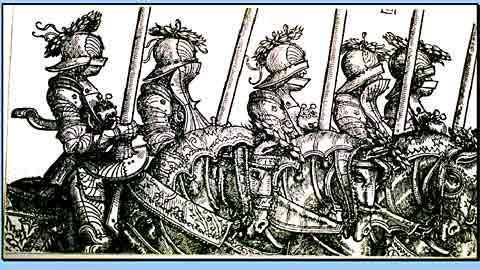
So that fascinating thing I hinted at about the setting in my last post about Le Morte D’Arthur – it’s totally generic McEurope, but instead of this being a design flaw, it’s a design feature.
Actually calling it McEurope is too specific. It’s more McMedieval Feudalism seen from the top without ever looking down. It’s an aristocracy divorced from all other social classes with an endless supply of weapons and armor to fight with. You have to at least enjoy that stuff as aesthetic trappings without any attendant realism. Only once does someone go to town and see a craftsperson to get a thing fixed. That’s your realism. Peasants hardly ever appear in it, and knights apparently have nothing better to do than stand all day beside bridges challenging whomever happens to walk by. “None shall pass”, etc.

What locales there are all blend together. Bridges, cloisters, and wells with maidens (or knights) weeping beside them lend some decoration to the otherwise indistinguishable setting. There are castles, and outside every castle is a forest. Inside the forest adventures happen.
But I said this is a feature rather than a flaw. What makes it fascinating is how quickly bright sanitized McMedieval Feudalism can become weird foreboding mythic id-laden fairyland. The one rule is when you go into the forest stuff happens to you. That stuff can be the frat-house jousting (with accompanying sides of homoeroticism and misogyny), or something a lot weirder and subconsciously ripe. It’s no surprise that “the forest” gets transformed into “the wasteland” during the Grail Quest.

What to make of this? On one hand the setting is so bland and divorced from reality as to be nonsensical. On the other hand that blandness has an advantage when telling a story and playing with archetypes, especially because the bland is divided in half, a mundane world and its fantastic reflection, and the archetypes are never quite certain when the one will shift into the other. Not just this, but any deviation from the uniform setting stands out.
So it’s okay to be bland as long as it’s a conscious choice. Use it to your advantage. Dive deep and swim in the dark waters waiting beneath the bland’s placid surface. Find those pearls waiting down there along with those toothsome beasts. What you find might be wonderful or it might be ugly, but it won’t be bland. That’s for certain.
To Trunk Or Not To Trunk
Reasons to trunk a story:
- If it were published you wouldn’t tell anyone and you’d hope no one would read it.
- You know it’s not together yet. Parts might be working, but parts aren’t. It will simply accrue rejections and thereby limit its markets for when you do figure it out in the future. Put these on the trunk’s top shelf. Months from now you might know exactly what needs to be done with them.
- You’ve seen hundreds of stories exactly like it in the slush and yours isn’t any better.
- Better a story go in the trunk then e-pub it and guilt all your friends into buying it.
With the caveat:
NEVER THROW ANYTHING OUT.
Images. Millions of Images. That’s What I Need.

Like most people I have folders and folders full of pictures glommed from all over the Internet. Lately I’ve been making crude collages with them on power point. The above is for a short story about a junky ghost hunter and the codependent relationship he has with his assistants. I made it after the story was written, which is a bit different than using it to brainstorm.
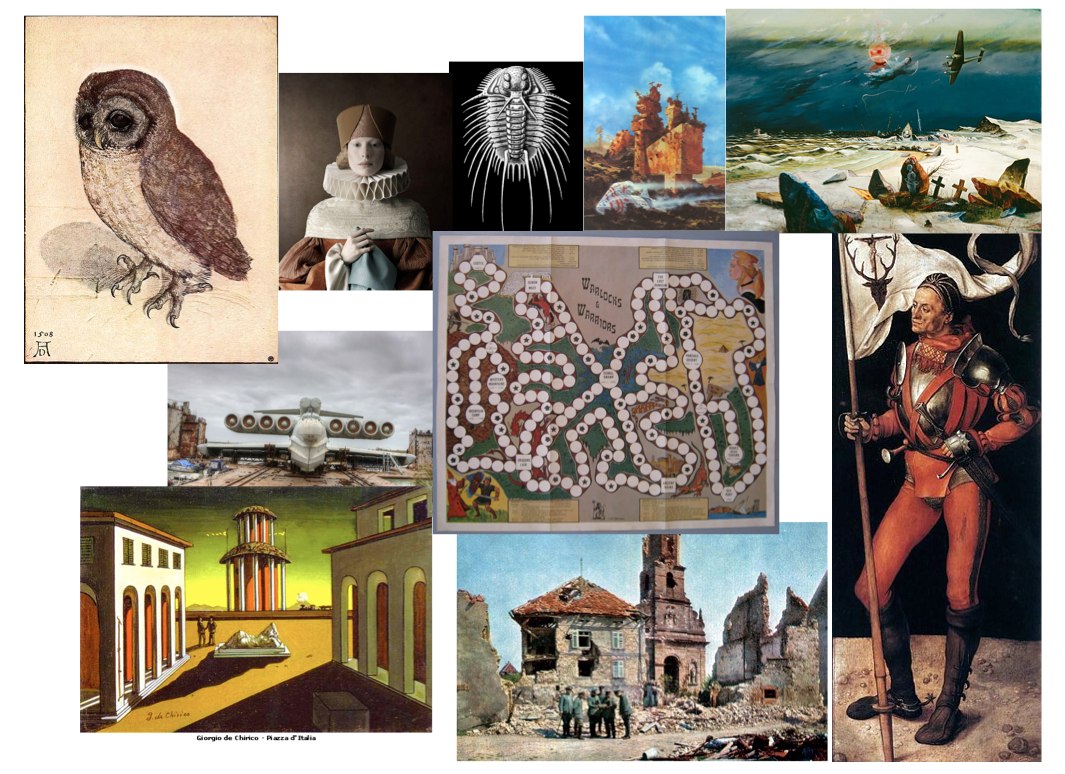 That’s one for a story in process. It hasn’t come together yet like the first one, but that’s likely because the story’s not done. Evocation’s my goal, and there’s a tendency to be prejudiced towards the chosen images and using them to illustrate the story, as opposed to finding the pictures that evoke the story best.
A Few Things
I’m putting these here so I remember them.
John Coulthart has a great post on past attempts to produce covers for M. John Harrison’s Viriconium sequence. Am I fan of Harrison? Of course I’m a fan. Coulthart then has a follow-up post on what he’d like to see in new covers. Speaking of Viriconium, over at M. John Harrison’s blog there’s a new piece of fiction set in that city.
Another thing…
This essay by Ursula K. LeGuin over at Book View Cafe. I can’t agree with it enough. How about these quotes:
Literature is the extant body of written art. All novels belong to it.
The value judgment concealed in distinguishing one novel as literature and another as genre vanishes with the distinction.
Every readable novel can give true pleasure. Every novel read by choice is read because it gives true pleasure.
And finally, a poem by Meng Jiao (a Tang Dynasty poet):
Wanderer’s Song
The thread in the hand of a kind mother
Is the coat on the wanderer’s back.
Before he left she stitched it close
In secret fear that he would be slow to return.
Who will say that the inch of grass in his heart
Is gratitude enough for all the sunshine of spring?
Translation Telephone
Jin received her copies of the John Shirley book Rapture that she translated. She wrote a blog post about it. It’s in Korean, but there are pictures.
The reaction from the Korean BioShock community has been interesting. Some people are annoyed that the book doesn’t match the fan-made patch (where one thing named INCINERATE got translated as FIREBALL ATTACK!) Other people are a bit confused as to who this John Shirley guy is anyways. Some folks thought Ayn Rand was made up by the creators of BioShock. And other folks are reading the book saying, “Oh. This is actually a fun book. The game has more of a sense of humor than we realized.”
It’s been interesting. Part of it makes me think how translation can be like one massive game of telephone. Another thing it makes me realize how making guesses based on limited information may not be a problem now. But later down the line when your guesses have been codified into being considered “the truth” problems will arise.
I’m So Happy. *COUGH*COUGH*
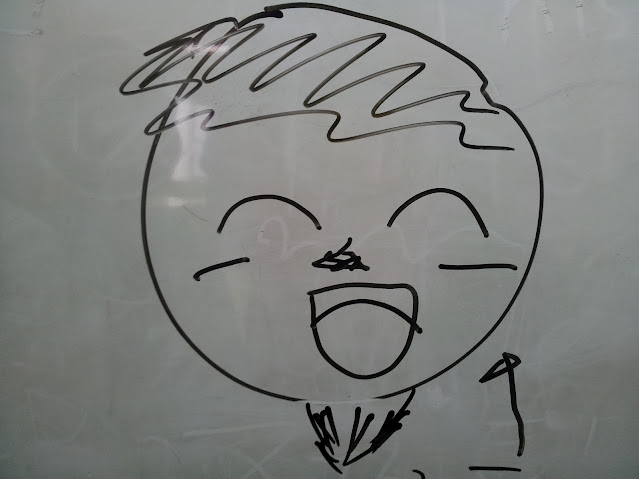
Another portrait by one of my students. Dig the Maynard G. Krebs beard.
Still coughing and limping. I went back to the doctor’s for a check-up. I have another six days in my cast, but he says my ankle’s healing quite well.
From the Ray Bradbury Paris Review interview: “I type my first draft quickly, impulsively even. A few days later I retype the whole thing and my subconscious, as I retype, gives me new words. Maybe it’ll take retyping it many times until it is done. Sometimes it takes very little revision.”
That makes me think a bit.
Books and TV
Five people walk into a room. They’re all what may be called active readers in that they read at least a book or two a month. One of them brings up a book. None of the others have read it. One only reads award-winners and bestsellers, another is reading her way through Dickens (last year she did the same with Trollope), that guy only reads genre, as do the last two, but it’s a different genre than the first guy’s, and these two are reading at the opposite ends of it. Maybe there’s a book they have all read and can discuss. Inevitably this book will be tied in with a class somewhere at which point the conversation will drown itself in nostalgia.
Across the street, five people walk into a room. They’re all active television viewers. They follow at least one TV show a week. One brings up a show. They may not all like it, but they all talk about it. Conversation achieved.
Knowledge Presupposes Ignorance, or Ouch!
“A reason knowledge/learning in general is so unpopular with so many people is because very early we all learn there is a phenomenologically unpleasant side to it: to learn anything entails the fact that there is no way to escape learning that you were formerly ignorant, to learn that you were a fool, that you have already lost irretrievable opportunities, that you have made wrong choices, that you were silly and limited. These lessons are not pleasant. The acquisition of knowledge–especially when we are young–again and again includes this experience.
…
“Thus most people soon actively desire to stay clear of the whole process, because by the time we are seven or eight we know exactly what the repercussions and reactions will be. One moves toward knowledge through a gauntlet of inescapable insults–the most painful of them often self-tendered.”
– Samuel R. Delany, About Writing
“Shadows Under Hexmouth Street” at Beneath Ceaseless Skies


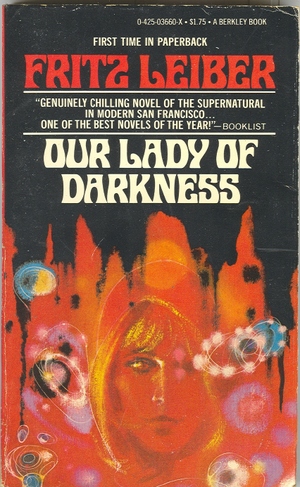
“Shadows Under Hexmouth Street” is my Joe Mitchell in Lankhmar story (mixed in with bits from my late aughties day job at an architectural preservation company).
Joe Mitchell was a 1940s New Yorker writer. That’s him over there on the left. He specialized in urban pieces about kooks and weirdos. Lankhmar’s a massive fantasy city created by Fritz Leiber. That’s it in the middle as drawn by Mike Mignola, the Hellboy guy. In the early 1970s Leiber published Our Lady of Darkness, there on the right. It wasn’t set in Lankhmar, but it featured a magic system called polisomancy. Polisomancy’s all about capturing urban elementals born from construction materials and was practiced by kooks and weirdos in cities.
My story’s about that.
World Building
I actually can’t stand hyper-real, “vivid” world-building. Leiber names maybe at most a dozen streets in Lankhmar and describes less than half a dozen neighborhoods — I’d be surprised if he mentions more than four neighborhoods.
However I realize I am in the minority with this opinion and wonder if the clotheshorse swordporn I hate so much might stem from audience overlap with the SCA that values that level of immersion.
Remember Lucas’s Law: The Clone Wars were so much better imagined than seen. The job is to write stuff wide enough for the reader or player to get lost in and shape on their own, than to shape it all for them and suck the life out of it.
(from an email discussion with some friends)
 Yesterweird