Orlando Furioso, Canto XVI
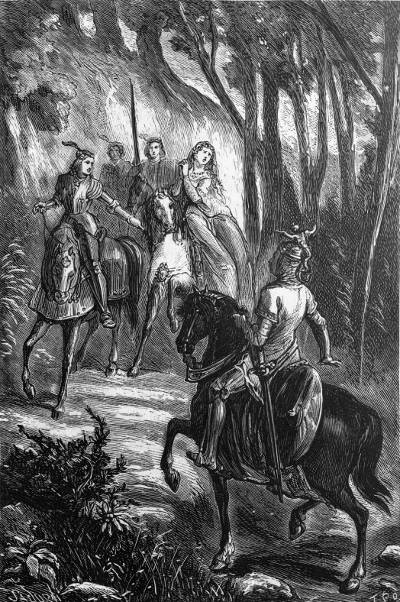
And here we are again.
Ariosto starts by telling us that he’s been unlucky in love too. He’s a sensitive guy after all and has felt the pain of being spurned. That done it’s back to Grifone sneaking away to Antioch to meet-up with the brazen Orrigille. She’s there with her new beau (as yet unnamed) to take part in a joust hosted by the King of Syria. Grifone’s itching to fight, but Orrigille doesn’t want him to kill her current boy-toy. She puts on a fake smile and embraces Grifone, saying how awful it was that he abandoned her. Her lover plays along, and they cool Grifone’s temper. In the end it’s himself who feels like he’s done wrong. The trio enters Antioch, and that’s where Ariosto leaves them.
Time to go back to Paris where a bajillion knights battle on.
A lot of these guys get named only to get killed a few lines later. The main part though is Rodomonte killing everybody, and I mean EVERYBODY he meets in Paris. Old man? Dead. Child? Dead. Fair maiden? Dead. He’s also setting fire to the city as he goes. It’s a grisly scene full of terror, and the Saracens would’ve won if they had followed behind him, but Rinaldo and his English reinforcements appeared. Rinaldo rallies the troops with a long speech and then the battle starts.
This is the meat of the canto, but difficult to summarize. I’ll say it’s a montage of mayhem. Spears break. People die. It’s grisly.
“And where you see one dying soldier lie,
Another he has slain lies stretched near by.”
Ferrau’s favorite lyre-boy dies. Zerbino is unhorsed and nearly killed. Bambirago and Agricalt, whoever the heck they are, die. Pauliano, too. Did I make up that last guy? I don’t know. At last, Charlemagne hears word that Rodomonte’s killing everyone and the city’s on fire. The king pulls back to save the city, and the tide of battle turns again.
But that’s a story for another canto.
CANTO SCORE CARD
Knights: Grifone, Orrigille’s as yet unnamed current beau, Rodomonte, Rinaldo, Zerbino, Lurcanio, Ariodante, Ferrau, a bajillion others (the Guidos! AGAIN!) some of whom are only named a line or two before they die.
Mages: 0
Damsels: Orrigille the not-so-innocent
Horses: Baiardo, Rinaldo’s horse
Swords: Fusberta, Rinaldo’s sword
Monsters: None really, although some of the Saracen knights are descended from giants
Magic Items: Rodomonte’s Dragon Power Armor either burns and/or makes its wearer immune to fire
(My favorite thing about this canto is the illustration above. It could literally be captioned, “Holy shit! Is that your ex?”)
Orlando Furioso, Canto XV

This one’s long and has a bajillion names in it so buckle up kids, it’s time to get FURIOSO!
Last we left off, the Saracen army was attacking the walls of Paris. Knights were dying every which way and Rodomonte was leaping over flaming trenches to get inside the city. We get back to that in this canto, but first Ariosto has to do some ass-kissing/state craft commentary. Lots of advice against killing everybody including your own troops in order to achieve your goals and stuff like that. Basically, don’t be a Rodomonte.
“Eleven thousand men and twenty-eight
Amid that raging holocaust lay dead.
Unwillingly they went to meet their fate,
Unwisely by so great a leader led.”
Then of course we hear about another bajillion named knights: King Bambirago, Baliverzo, Corineo, Prusion, Malabuferso, Ugier the Dane, Salamone, the Guidos, both Angelins, Namo and his sons Avolio, Otto, Avino, and Berlingier, and many more. Are any of these people important? I don’t know. It’s a mad brawl and everyone is killing everyone, but Ariosto decides he wants to go back to Astolfo.
Who is Astolfo you ask? Well, he is a guy from a few cantos ago.
To refresh your memories he was one of Alcina’s former lovers who got turned into a tree and told Rindalo? Ruggiero? Ruggiero to watch out for her. I think he’s also related to the king of England and might be in line for the throne. After Alcina’s defeat, he’s hung around with Logistilla and her people, but now it’s time to go back home. So he sets sail with a couple of Logistilla’s handmaidens (Sofrosina and Andronica) and because Alcina’s power doesn’t extend to Persia and Arabia he figures he can sneak past her by going that way. Logistilla also gives him a couple of magic items: a book (a Guide Against Enchantment) and a horn (pretty much a Horn of Blasting for you gamer nerds). Once outfitted, and “with a favourable wind to poop,” Astolfo is off. As they go Andronica talks about Italian explorers who she sees in the future discovering a new land somewhere in the sea and how great it is that Christianity will be brought to these places.
Yeah…
There’s also a long aside here about a historical figure named Andrea Doria. He was a statesman/mercenary captain from Genoa, and I only bring him up because I want to share this painting of him as an elderly thirst trap.

Once all that’s done and the travelogue finishes up, Astolfo reaches the east coast of Africa (around Ethiopia) and disembarks. At which point he is given a horse, and not just any horse, but a *magic* horse named Rabicano. Now Astolfo is ready. First person he encounters is a holy man who says there’s a terrible giant nearby who kills all travelers so wise-up son and don’t go that way. But Astolfo is a knight and he says that sounds like someone that needs killing! So the holy man tells Astolfo how the giant has a magic net (forged by Vulcan) he lays under the sands to trap his victims before taking them back to his lair for slaughter. Astolfo thanks the hermit and makes for the giant’s abode.
The giant’s name is Caligorante and his place is covered in bones and grisly trophies, naked torsos and limbs and all that mess. He sees Astolfo approaching and gets giddy anticipating the killing. But Astolfo uses his horn first and the blast scares Caligorante so bad he takes off running, only to get caught in his own trap. As Caligorante struggles, Astolfo approaches with sword in hand ready to lop off his head – but at the last minute Astolfo relents. Instead, he keeps the giant bound and decides to parade him throughout the land. So that’s what he does, making straight for Cairo. Everyone there is very impressed, and they tell Astolfo about another horrible giant named Orrilo.
Orrilo lives in the dread domain next door and is the enchanted offspring of a sprite and a fairy, born to do men spite. His magic power is that he can reattach limbs when they get chopped off. This is described as like when two beads of mercury draw together and rejoin, so I imagine him sort of looking like Odo from Deep Space 9.
When Astolfo gets there he finds two knights already fighting Orrilo. These guys are the sons of Oliver (?) and they’re names are Grifone the White and Aquilant the Black. They’ve already killed Orrilo’s giant crocodile and now are making to fight the giant. But no matter how many times they lop off his head or hack off a limb, Orrilo laughs and simply reattaches it.
“Down to his teeth Grifone splits his skull
And Aquilante splits it to his chest,
On him such mortal blows are void and null.
He laughs: the sons of Oliver are vexed.”
While the knights fight Orrilo their adoptive moms watch from nearby. Like plenty of others in this fakakta book Grifone and Aquilant have the Achilles problem where bad things are prophesied to happen to them if they leave home, so their moms are doing what they can to prevent their going. The moms step in when their knights are near to exhaustion and tell Orrilo to go home, which he does. Astolfo then rides up, glad to see the brothers, and all return to a nearby castle to recover. (They leave Caligorante tied up outside.)
Over dinner Astolfo pulls out Logistilla’s magic book and reads the entry for monsters like Orrilo. He discovers the giant can be killed if a certain hair is plucked from his head. But which one? That’s the puzzle. He asks the brothers if it would be all right if he fought Orrilo tomorrow. The brothers are like go ahead, it’s cool. So next day Astolfo and Orrilo in combat engage.
There’s stabbing and smacking, Orrilo’s dismembered like the Black Knight from Monty Python and the Holy Grail, but no matter how many times he slices the giant Astolfo can never figure out which hair he needs to pluck from the beast’s head. Finally he chops off Orrilo’s head and runs away with it while the body chases after him. Astolfo hops on Rabicano and as he rides away he searches the head for the hair. In the end he can’t find it so he decides to shave the entire thing. He sticks his fingers up the giant’s nose to hold it steady (a detail apparently forever lodged now in my head). This works, because once the head is shaved the giant’s torso falls down dead. Astolfo then rides back to town to show off, because why not?
But wait! There’s more!
Astolfo convinces Grifone and Aquilant to leave home and come with him back to Europe by way of the Holy Land. Their moms are sad, but so it goes. Along the way they meet a knight from Mecca named Sansonet, who converted to Christianity at Orlando’s request. Sansonet is helping to build a fort against the Caliph and he welcomes the travelers and escorts them to Jerusalem. Once there Astolfo gives Caligorante to Sansonet as a gift and Sansonet gives Asolfo a sword (so far unnamed) and a set of spurs that once belonged to Saint George. And being Christian knights in the Holy land, all three tour the sites and spend time mediating in monasteries. As they prepare to leave they run into a Greek traveler who tells them all about the girl Grifone loves. Her name’s Orrigille and she’s BAD.
“For she, a woman in the bloom of youth,
No more could bear to sleep alone, in truth.”
And before anyone can stop him Grifone sneaks off to Antioch where he knows Orrigille has gone.
But that’s a story for another canto.
CANTO SCORE CARD
Knights: A bajillion (the Guidos!), Rodomonte, Astolfo, Grifone the White and Aquilant the Black, Sansonet
Mages: Queen Logistilla and her hand maidens Sofrosina and Andronica, a holy hermit, the evil Alcina mentioned in passing
Damsels: Orrigille the not-so-innocent
Horses: Rabicano
Swords: As yet unnamed sword Sansonet gives Astolfo
Monsters: Caligorante the Giant, Orrilo the non-dismemberable Giant, Orrilo’s giant crocodile
Magic Items: Logistilla’s Guide Against Enchantment (it counters spells and is full of magic lore), a horn of blasting, Vulcan’s Net of Entrapment, the Spurs of Saint George
Orlando Furioso, Canto XIV
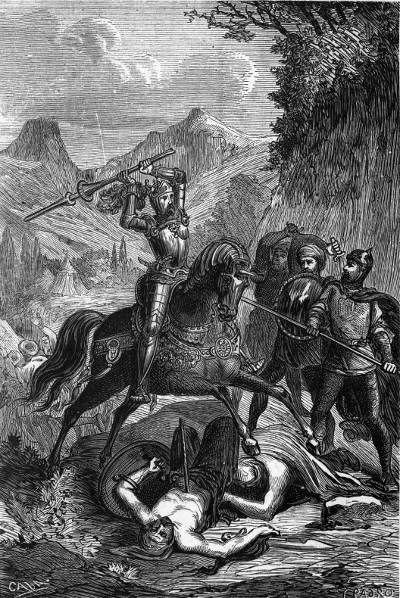
This one has everything.
We get some historic details, some ass-kissing by Ariosto for his patrons. We get a list of names, all knights fighting for or against Charlemagne. We get a damsel being “rescued”. We get massive grand battles. We even get some of that yesterweirdness I love.
After the historic details (the state of the war this far), some ass-kissing (dealing with his patron’s sacking of Ravenna: “We feel too much the anguish and the woe // Of weeping women garbed in widows’ weeds, // The sad young victims of your valiant deeds.”), and a roll call of the Saracen army (Marsilio, Agramante, Brunello, Isolier, Folvirant, &c), we come at last to the Saracen knights who are the primary movers of this canto, Mandricardo and Rodomonte.
Orlando killed Mandricardo’s father at some point earlier. Now Mandricardo wants revenge. Driving home the Iliad homage, Mandricardo wears Hector’s armor after finding it in a tower in Syria and has recently arrived in Europe. He is not happy to sit in a siege, so he decides to hie off and seek adventure/glory/Orlando elsewhere. Very soon he finds survivors of Orlando’s earlier onslaught and they point Mandricardo on to where the battle was fought. Unfortunately, Orlando’s already gone by the time Mandricardo arrives, and so the search continues. Soon he comes upon a band of knights camped by the Tiber.
A parley starts with Mandricardo asking who they are. They say they’re from Granada and have come to escort the King’s daughter to Rodomonte since the two are betrothed. Mandricardo asks if he might maybe possibly get a peek at this princess, but the guard refuses. So Mandricardo kills him and all the other guards. Stabby. Stabby. Stabby (with a spear because Mandricardo doesn’t use a sword for reason’s mentions under Swords below). Killing done he goes to find the princess. Her name’s Doralice. She woke mid combat, tried to flee, but failed. Now she cowers from Mandricardo, but her beauty is so great it weaves a web of love around his heart. And so he abducts her. Content with his prize, he’s less keen on finding Orlando and he starts to pitch woo to Doralice. Eventually the two shelter in a cottage for the night.
“What in the darkness of the night befell / Between the Tartar and the young princess / I cannot, I regret, precisely tell, / So everyone must be content to guess. / I think that they agreed together well / For in the morning they arose no less / But rather more content”
In the morning they return to wandering and soon come upon two knights and a fair maid, but you’ll have to wait to hear about that later, because now it’s time for CHURCH!
King Agramant has heard that Rinaldo and a host of fresh knights are on the way from England to help Charlemagne, so Agramant wants to attack Paris in the morning. Knowing that the Saracens plan to attack, Charlemagne goes to mass. A whole lot of Catholic pomp gets described, communion hosts, confessions, how all the paladins and princes in Paris went to church too. And the prayers are so loud they reach the Big G, God Himself, in heaven. He hears all this and sees the threat to Christendom and decides to join the fray. (This is more inspired by the Iliad than by either Testament). God commands the Archangel Michael to find Silence and Dame Discord, the first to help the English knights sneak across France, the second to sow strife among the Saracens.
This bit delivers the weird.
Michael flies around searching for Silence. At first, he hears that Silence likes to hang out in monasteries, but when Michael arrives at one he discovers that Silence, Peace, Quiet, and Love have all left the monasteries and been replaced by Greed, Wrath, Cruelty, and the rest. In fact who should he find in the monastery but Dame Discord hanging around with a pack of lawyers. Well, Michael figures, that’s half the task done and he tells her what God wants from her. She sets off, but not before telling Michael that Fraud might know where Silence can be found. Michael finds Fraud and she tells him how Silence had taken up with Treachery and Homicide, but still visits the House of Sleep. Off then Michael flies to the House of Sleep where he finds Silence working as something of a security guard in slippers. Silence via gestures asks what Michael wants, and when Michael tell Silence God’s orders (in a whisper natch) Silence sets off right away.
Meanwhile, Agramant’s attack is ready. This guy is over there, this guy is over there, Charlemagne does this and barricades that and for a bit it’s like listening to war gamers go on but eventually Ariosto takes us into the action of siege warfare where Rodomonte (Algerian King, betrothed to Doralice who unbeknown to him Mandricardo is likely diddling at that very moment) hews down Christians right and left. His armor is made of ancient dragon skin, crafted by his ancestor who on the plain of Babel built a tower to challenge God’s majesty. It grants him great strength and invulnerability as if he was a Space Marine.
More hewing and more death ensues. It gets quite grisly. But…
“Discordant concert and harsh harmony / Of shrieks and wailing, fearful to relate, / Of anguished victims in their agony, / Led by so great a leader to their fate, / Were mingled in a strange cacophony / With raucous roarings of primeval hate. / My lord, this canto has now run its course, And I must rest awhile, for I am hoarse.”
CANTO SCORE CARD
Knights: A skazillion named Saracen knights, a skazillion earlier named English Knights, a skazillion Christian knights named as they die, Rodomonte, Mandricardo, Rinaldo
Damsels: Doralice, princess of Granada, betrothed to Rodomonte, abducted by Mandricardo
Mages: None except those Monsters below
Monsters: God (the Big G), Angels, personifications of various things like Silence, Fraud, and Dame Discord who are described as sitting squarely between Ovid’s cosmology and Neil Gaiman’s Endless.
Horses: None are named, but there’s one I’m keeping my eye on because it might be important.
Swords: Durindana lore (this is Orlando’s sword now but once belonged to Mandricardo’s dad, and way long ago belonged to Hector.)
Magic Items: Hector’s Armor (worn by Mandricardo), Rodomonte’s dragon-scale power armor
Orlando Furioso, Canto XI

Knights: 5+ (Ruggiero, Orlando, Bradamante, Oberto King of Ireland, Bireno the bastard who did Olimpia dirty, and probably a bunch of unnamed Irish knights)
Damsels: 2 (Angelica and Olimpia)
Monsters: 3 (the hippogriff (it gets tired of Ruggiero and flies off to deus ex machina elsewhere), the Orc (RIP), and a giant (defeats Bradamante)
Swords: 1 (Orlando’s Durindana)
Horses: unknown and unnamed
Wizards: ? (a couple mentioned in passing)
In this canto nothing much happens that we haven’t already seen.
A knight (Ruggiero) seeks to assault Angelica. Angelica flees by magical means (she still has the magic ring from last canto). Ruggiero sets off in search of her. Both stumble into their own unrelated adventures. One being Ruggiero witnessing his beloved Bradamante get defeated by a giant.
Then it’s back to some other knight and that one goes to a place we’ve already seen (the Isle of Tears where the Ebudans feed women to the Orc) and the earlier scene plays out again only this time it’s different.
Now it’s Olimpia about to get fed to the Orc and it’s Orlando who shows up to save her. The Orc gets killed (Orlando drags it out of the sea with an anchor) and the Ebudians are massacred by the Irish. Then the king of Ireland, Oberto, glimpses Olimpia and instantly falls in love with her. (She’s naked.) Orlando asks her how she got there, since last he saw she was about to get happily married. She then relates her tale of woe and betrayal by Bireno, and the Irish king is like “Well, stay with me and I’ll give you your kingdom back.” She does and that all gets taken care of in a couple of stanzas.
Meanwhile, Orlando goes off to do his own thing and Ariosto says Orlando did so much cool stuff but Ariosto can’t talk about it all because then this book would be even longer than it already is.
The end.
Along in there Ariosto uses the word “lover” to mean perspective rapist, and we get a few stanzas concerning the evils of guns and a few more talking about how sexy and white the naked Olimpia is.
A yawn all around.
I hope it will pick up some in the next canto.
 Yesterweird